
Short answer
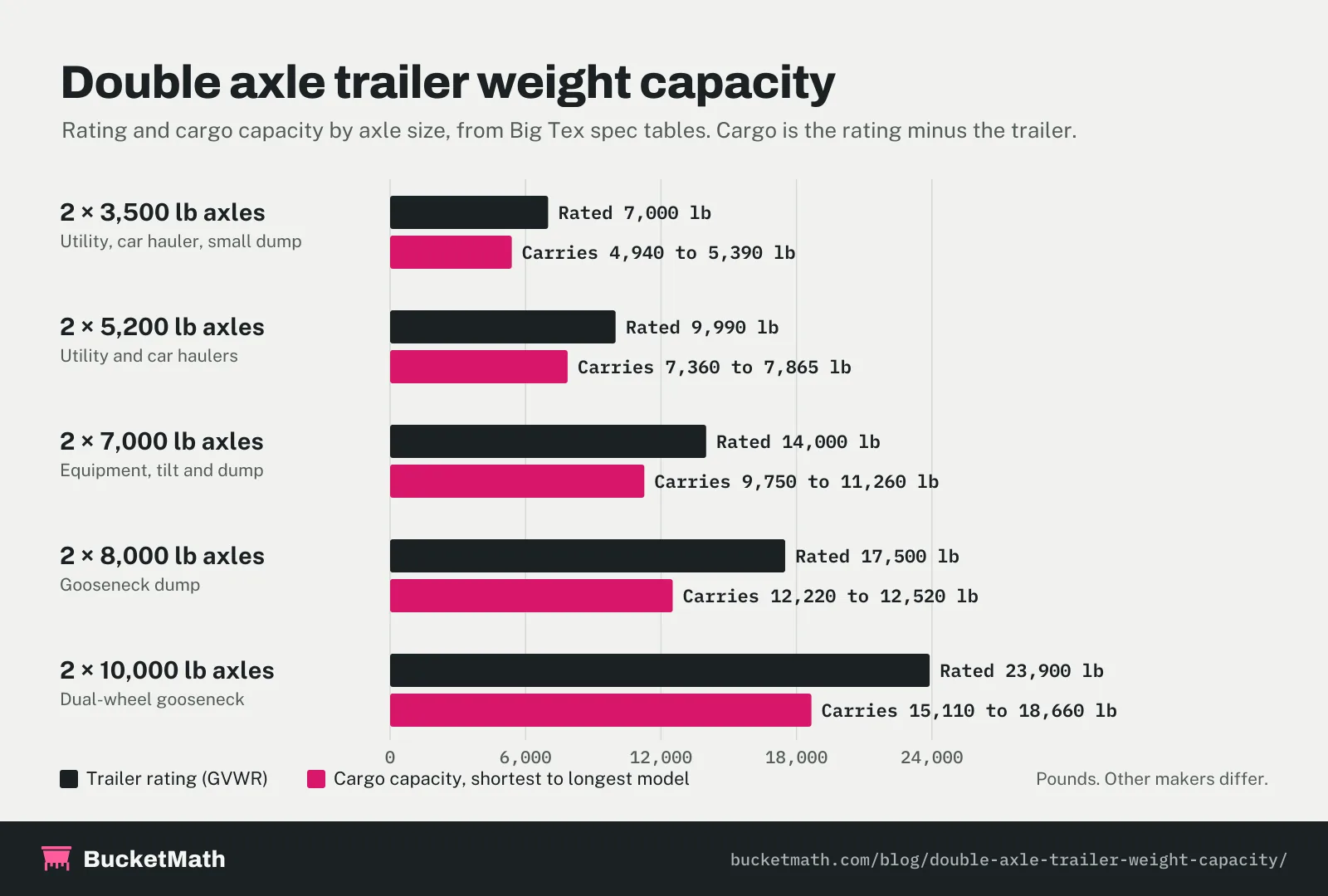
A double axle (tandem) trailer is rated at roughly the sum of its two axles, and it can carry that rating minus its own weight. Two 3,500 lb axles give a 7,000 lb trailer that carries about 5,000 lb. Two 5,200 lb axles give a 9,990 lb trailer that carries about 7,500 lb. Two 7,000 lb axles give a 14,000 lb trailer that carries about 10,000 to 11,000 lb. The exact figure is on the trailer’s label.
Double axle, dual axle, tandem axle and 2 axle all mean the same thing: a trailer with two axles set close together. Below is what each common axle size is rated for and can carry, why the rating is not always the two axles added together, and how to find the number for your own trailer.
Double axle trailer weight capacity by axle size
| Axles and trailer type | Rating (GVWR) | Cargo capacity |
|---|---|---|
| 2 × 3,500 lb Utility, car hauler, small dump | 7,000 lb | 4,940 to 5,390 lb |
| 2 × 5,200 lb Utility and car haulers | 9,990 lb | 7,360 to 7,865 lb |
| 2 × 7,000 lb Equipment, tilt and dump | 14,000 lb | 9,750 to 11,260 lb |
| 2 × 7,000 lb Bumper-pull deck-over | 15,400 lb | 11,220 to 12,150 lb |
| 2 × 7,000 lb Gooseneck flatbed, 20 to 40 ft | 15,900 lb | 8,710 to 11,630 lb |
| 2 × 8,000 lb Gooseneck dump | 17,500 lb | 12,220 to 12,520 lb |
| 2 × 10,000 lb, dual wheels Gooseneck flatbed, 20 to 40 ft | 23,900 lb | 15,110 to 18,660 lb |
The pattern is consistent: the trailer itself takes about a quarter of the rating on a bumper-pull trailer, so cargo capacity is roughly 70 to 80 percent of the GVWR. Longer and heavier-built trailers carry less, because more of the rating goes to the trailer.
How much weight can a trailer with two 3,500 lb axles carry?
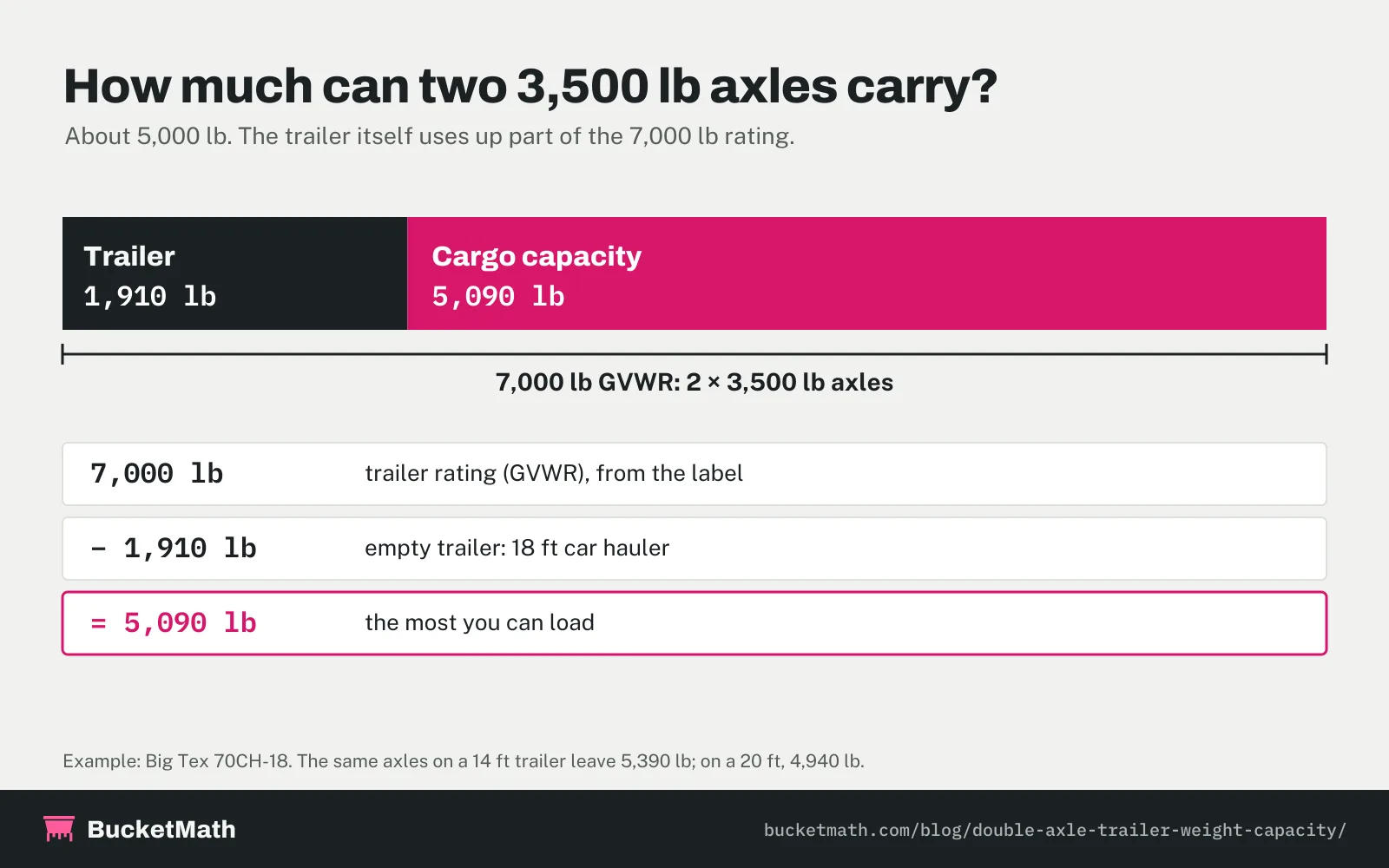
About 5,000 lb. Two 3,500 lb axles make a 7,000 lb trailer, and the trailer weighs 1,600 to 2,100 lb on its own. What is left is what you can load.
| Trailer | GVWR | Empty | Cargo |
|---|---|---|---|
| 60PI-12 Utility, 12 ft | 6,000 lb | 1,265 lb | 4,735 lb |
| 60PI-16 Utility, 16 ft | 6,000 lb | 1,535 lb | 4,465 lb |
| 70PI-14 Utility, 14 ft | 7,000 lb | 1,780 lb | 5,220 lb |
| 70PI-20 Utility, 20 ft | 7,000 lb | 2,020 lb | 4,980 lb |
| 70CH-14 Car hauler, 14 ft | 7,000 lb | 1,610 lb | 5,390 lb |
| 70CH-18 Car hauler, 18 ft | 7,000 lb | 1,910 lb | 5,090 lb |
| 70CH-20 Car hauler, 20 ft | 7,000 lb | 2,060 lb | 4,940 lb |
| 70SR-10 Dump, 10 ft | 7,000 lb | 1,730 lb | 5,270 lb |
Note the 60PI: it has the same two 3,500 lb axles but Big Tex rates it at 6,000 lb, not 7,000. The label decides, not the axle count.
Two 5,200 lb axles: about 7,500 lb
Two 5,200 lb axles add up to 10,400 lb, but Big Tex rates these trailers at 9,990 lb. They carry 7,360 to 7,865 lb.
| Trailer | GVWR | Empty | Cargo |
|---|---|---|---|
| 10PI-16 Utility, 16 ft | 9,990 lb | 2,260 lb | 7,730 lb |
| 10PI-20 Utility, 20 ft | 9,990 lb | 2,380 lb | 7,610 lb |
| 10CH-18 Car hauler, 18 ft | 9,990 lb | 2,125 lb | 7,865 lb |
| 10CH-20 Car hauler, 20 ft | 9,990 lb | 2,280 lb | 7,710 lb |
| 10DM-18 Steel-floor car hauler, 18 ft | 9,990 lb | 2,480 lb | 7,510 lb |
| 10DM-20 Steel-floor car hauler, 20 ft | 9,990 lb | 2,630 lb | 7,360 lb |
A 9,990 lb rating keeps the trailer at or under 10,000 lb, the line in the federal rule for Class A commercial licences (49 CFR 383.91). Our trailer weight calculator checks that line for your truck and trailer.
Two 7,000 lb axles: about 10,000 to 11,000 lb
A bumper-pull trailer on two 7,000 lb axles is rated 14,000 lb and carries roughly 9,750 to 11,260 lb. Deck-over and gooseneck versions of the same axle pair are rated higher.
| Trailer | GVWR | Empty | Cargo |
|---|---|---|---|
| 14PI-16 Utility, 16 ft | 14,000 lb | 2,740 lb | 11,260 lb |
| 14PI-20 Utility, 20 ft | 14,000 lb | 3,040 lb | 10,960 lb |
| 14TL-20 Tilt equipment, 20 ft | 14,000 lb | 3,460 lb | 10,540 lb |
| 14TL-22 Tilt equipment, 22 ft | 14,000 lb | 3,660 lb | 10,340 lb |
| 14LP-12 Dump, 12 ft | 14,000 lb | 3,870 lb | 10,130 lb |
| 14LP-16 Dump, 16 ft | 14,000 lb | 4,250 lb | 9,750 lb |
| 14OA-16 Deck-over, 16 ft | 15,400 lb | 3,250 lb | 12,150 lb |
| 14OA-24 Deck-over, 24 ft | 15,400 lb | 4,050 lb | 11,350 lb |
| 14GN-20STA Gooseneck flatbed, 20 ft | 15,900 lb | 4,270 lb | 11,630 lb |
| 14GN-40STA Gooseneck flatbed, 40 ft | 15,900 lb | 7,000 lb | 8,900 lb |
So do two 7,000 lb axles equal 14,000 lb? On a standard bumper-pull trailer, yes. But Big Tex rates its deck-over at 15,400 lb and its gooseneck at 15,900 lb on the same axles, because part of a trailer’s weight rests on the truck through the hitch rather than on the axles.
Why the rating is not always the two axles added together
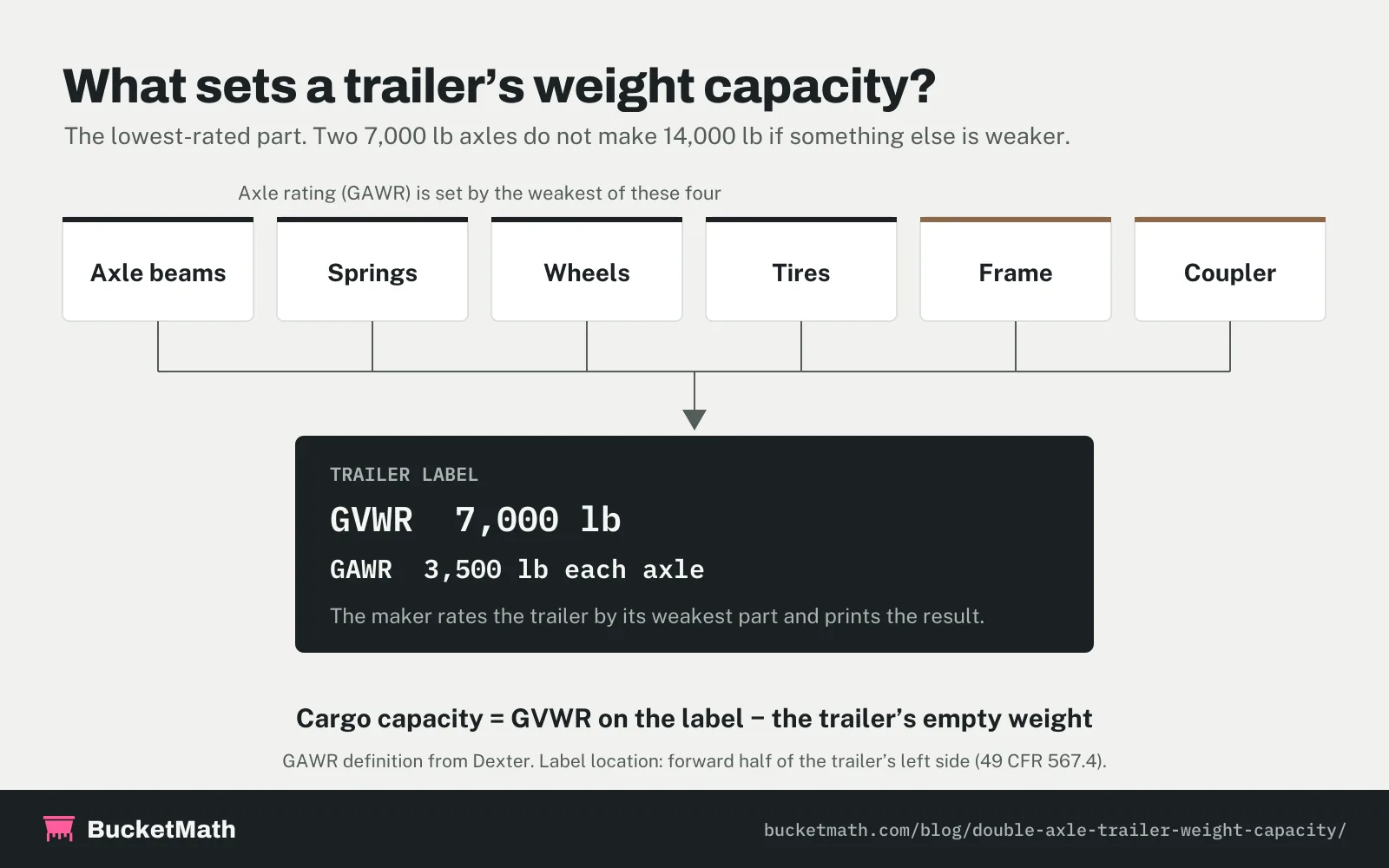
- The weakest part sets the axle rating. Axle maker Dexter defines GAWR as the capacity of the running gear set by its lowest-rated component: the axle beam, the suspension, the wheels or the tires.
- Makers rate some trailers below the axle total. Examples above: 6,000 lb on two 3,500 lb axles, and 9,990 lb on two 5,200 lb axles.
- Some are rated above it. The hitch carries part of the load, so a 15,400 lb or 15,900 lb rating on two 7,000 lb axles is possible.
- The frame and coupler have limits too. A trailer is only as strong as its lowest-rated part.
That is why swapping in heavier axles does not raise a trailer’s capacity on its own. The number that counts is the GVWR the maker printed.
How to find your trailer’s weight capacity
- Find the trailer’s label. Federal rules put it on the forward half of the left side, readable from outside (49 CFR 567.4). It lists the GVWR and the GAWR for each axle.
- Find the empty weight on the maker’s spec sheet or title paperwork, or weigh the empty trailer on a scale.
- Subtract: GVWR minus empty weight is the most cargo you can load.
- If the trailer label is gone, check the axles. Dexter puts its axle label on the side of the axle facing the rear bumper, and it shows the axle capacity. Treat that as an upper limit, not the trailer’s rating.
- When the load is close to the limit, weigh the loaded trailer.
How much does a double axle trailer weigh?
Empty, a tandem trailer weighs from about 1,300 lb for a short utility trailer to 7,000 lb or more for a long gooseneck. Length and build matter more than the axle rating.
| Trailer | Axles | Empty weight |
|---|---|---|
| Utility, 12 to 20 ft | 2 × 3,500 lb | 1,265 to 2,020 lb |
| Car hauler, 14 to 20 ft | 2 × 3,500 lb | 1,610 to 2,060 lb |
| Utility, 16 to 20 ft | 2 × 5,200 lb | 2,260 to 2,380 lb |
| Car hauler, 18 to 20 ft | 2 × 5,200 lb | 2,125 to 2,630 lb |
| Utility, 16 to 20 ft | 2 × 7,000 lb | 2,740 to 3,040 lb |
| Tilt equipment, 20 to 22 ft | 2 × 7,000 lb | 3,460 to 3,660 lb |
| Dump, 12 to 16 ft | 2 × 7,000 lb | 3,870 to 4,250 lb |
| Gooseneck flatbed, 20 to 40 ft | 2 × 7,000 lb | 4,270 to 7,190 lb |
Double axle trailer weight limit: rating vs. road law
There are two different limits. The first is the trailer’s own rating, covered above. The second is road law for heavy trucks: on the Interstate system, federal rules cap a single axle at 20,000 lb, a tandem axle at 34,000 lb and the whole vehicle at 80,000 lb (23 CFR 658.17).
In that rule, a tandem axle means two or more axles in a row spaced more than 40 in and not more than 96 in apart (23 CFR 658.5). Those figures are for semi-trailers. A pickup-towed tandem trailer rated 7,000 to 24,000 lb reaches its own label limit long before it reaches them, so the label is the limit that applies to you.
Single axle vs. double axle capacity
| Single axle | Double axle | |
|---|---|---|
| Axles | 1 × 3,500 lb | 2 × 3,500 lb |
| Trailer rating (GVWR) | 2,995 lb | 7,000 lb |
| Empty weight | 663 to 1,073 lb | 1,780 to 2,020 lb |
| Cargo capacity | 1,922 to 2,332 lb | 4,980 to 5,220 lb |
With the same 3,500 lb axles, the second axle more than doubles what the trailer can carry here, because the single axle trailer is rated at 2,995 lb rather than the full 3,500. For one-axle trailers by deck size, see our single axle trailer weight capacity chart.
What size double axle trailer do you need for a machine?
Match the machine’s operating weight to cargo capacity, not to the trailer’s rating. These are the smallest Big Tex examples from the tables above that carry each machine on paper, before attachments.
| Machine | Smallest example trailer | It carries | Margin |
|---|---|---|---|
| Bobcat S70 skid steer 2,892 lb | 2 × 3,500 lb car hauler (70CH-18) | 5,090 lb | 2,198 lb |
| Bobcat E35 excavator 7,659 lb | 2 × 5,200 lb car hauler (10CH-18) | 7,865 lb | 206 lb |
| Bobcat S650 skid steer 7,901 lb | 2 × 7,000 lb tilt (14TL-20) | 10,540 lb | 2,639 lb |
| Kubota SVL75-3 track loader 9,190 lb | 2 × 7,000 lb tilt (14TL-20) | 10,540 lb | 1,350 lb |
| Kubota KX040-5 excavator 9,480 lb | 2 × 7,000 lb tilt (14TL-20) | 10,540 lb | 1,060 lb |
| Bobcat T770 track loader 10,515 lb | 2 × 7,000 lb deck-over (14OA-20) | 11,750 lb | 1,235 lb |
| Cat 308 CR excavator 18,610 lb | 2 × 10,000 lb gooseneck (22GN-20STA) | 18,660 lb | 50 lb |
Margins of 50 to 200 lb are not real margins: a spare bucket, a full fuel tank or mud uses them up. The Bobcat E35 and the Cat 308 CR in this table both need the next trailer up in practice. Run your own combination through the trailer weight calculator, which also checks tongue weight and your truck.
Loading a tandem trailer
- Keep each axle under its own GAWR as well as keeping the total under the GVWR.
- Put about 10 percent of the loaded weight on the hitch of a bumper-pull trailer. That is the figure Ford’s 2026 towing guide uses for conventional trailers over 2,000 lb, and it means the axles carry the other 90 percent.
- For loose material, work from weight, not volume. A cubic yard of dry gravel weighs about 2,835 lb, so a trailer with 5,000 lb of capacity carries under 2 cubic yards. Our gravel and stone calculators give tons for any area and depth.
Frequently asked questions
How much weight can a double axle trailer hold?
It depends on the axles. A trailer with two 3,500 lb axles is rated 7,000 lb and holds about 5,000 lb. Two 5,200 lb axles: rated 9,990 lb, about 7,500 lb. Two 7,000 lb axles: rated 14,000 lb, about 10,000 to 11,000 lb. Subtract the trailer’s empty weight from the GVWR on its label.
How much weight can a trailer with two 3,500 lb axles carry?
About 5,000 lb. The trailer is rated 7,000 lb and weighs 1,600 to 2,100 lb itself. Big Tex’s 7,000 lb car haulers carry 4,940 to 5,390 lb depending on length.
Do two 7,000 lb axles equal 14,000 lb capacity?
They usually give a 14,000 lb trailer rating, not 14,000 lb of cargo. A 14,000 lb bumper-pull trailer weighs about 2,700 to 4,300 lb empty, so it carries roughly 9,750 to 11,260 lb. The rating can also be lower if another part is weaker.
How much weight can a tandem axle trailer carry?
Tandem axle is another name for double axle, so the same numbers apply: about 5,000 lb on two 3,500 lb axles, about 7,500 lb on two 5,200 lb axles, and about 10,000 to 11,000 lb on two 7,000 lb axles.
What is the weight limit for a double axle trailer?
For your trailer, it is the GVWR on its label, commonly 7,000, 9,990 or 14,000 lb. Separately, federal Interstate rules cap a tandem axle at 34,000 lb, which applies to semi-trailers and is far above a pickup-towed trailer’s rating.
How much does a double axle trailer weigh?
Empty, about 1,600 to 2,100 lb for a 7,000 lb utility trailer or car hauler, 2,100 to 2,600 lb for a 9,990 lb trailer, and 2,700 to 4,300 lb for a 14,000 lb bumper-pull trailer. Long goosenecks weigh 7,000 lb or more.
Is a tandem axle the same as a double axle?
Yes. Tandem axle, double axle, dual axle and 2 axle trailer all describe a trailer with two axles set close together.
How do I find my trailer’s weight capacity?
Read the GVWR on the trailer’s label, which sits on the forward half of the left side, then subtract the trailer’s empty weight. The result is the most cargo it can carry.
Sources
- Big Tex Trailers spec tables: 60PI, 70PI, 70CH, 70SR, 10PI, 10CH, 10DM, 14PI, 14TL, 14LP, 14OA, 14GN, 16GX, 22GN, 30SA and 35SA, checked October 8, 2026.
- Dexter, Axles Glossary and How To Read an Axle Label.
- 49 CFR 567.4 (certification label), 23 CFR 658.17 and 23 CFR 658.5 (Interstate weight limits and definitions), and 49 CFR 383.91, via Cornell Legal Information Institute.
- Ford, 2026 RV and Trailer Towing Guide, for tongue weight.
- Machine weights from our equipment spec pages. Gravel weight from Engineering ToolBox, as used in our gravel calculator.
Big Tex, Dexter, Ford, Bobcat, Cat and Kubota are trademarks of their owners. BucketMath is independent and not affiliated with any of them. Ratings vary by maker and model, so go by the label on your own trailer; see our disclaimer.