
Enter your trailer and what you are hauling to get the loaded trailer weight, then check it against the trailer’s GVWR and axles, your truck’s tow rating and payload, and the Class A CDL line. It starts with real trailer and machine weights you can swap for your own.
Loaded trailer weight
11,361lb
| In tons | 5.68 US tons |
| Trailer can carry | 10,540 lb (GVWR 14,000 lb − 3,460 lb empty) |
| Trailer check | OK. 2,639 lb under the 14,000 lb trailer GVWR |
| On the hitch | 1,136 lb (10% tongue weight) |
| Axle check | OK. 10,225 lb on 2 × 7,000 lb axles (14,000 lb total) |
| Tow rating check | Enter your tow rating |
| Truck payload check | Enter your truck’s payload rating |
| Class A CDL line | Trailer is rated over 10,000 lb. Enter the truck GVWR to check |
Loaded trailer: 3,460 lb empty + 7,901 lb cargo = 11,361 lb. Tongue weight: 11,361 lb × 0.10 = 1,136 lb. On the trailer axles: 11,361 lb − 1,136 lb = 10,225 lb.
Estimate based on your inputs and the assumptions on this page. Disclaimer
How to calculate trailer weight
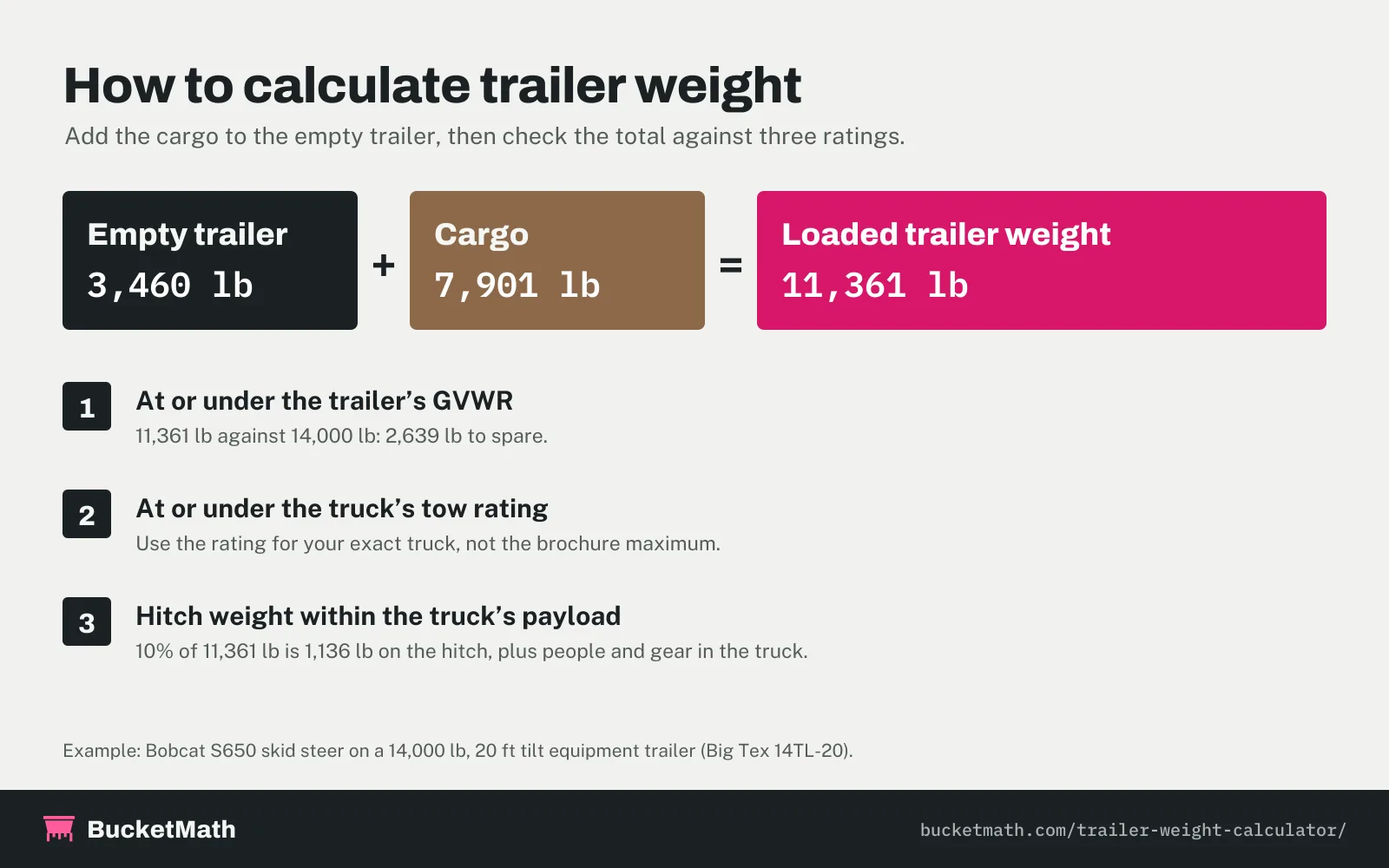
Loaded trailer weight = empty trailer weight + cargo. That total is also called gross trailer weight. Everything else is a comparison: the total against what the trailer is rated for, and against what the truck is rated to pull and carry.
- Find the trailer’s empty weight on the maker’s spec sheet, and its GVWR on the trailer’s VIN plate.
- Add up the cargo: the machine or material, plus attachments, fuel and tools.
- Add the two to get the loaded trailer weight. It must not exceed the trailer GVWR.
- Take 10 percent of the loaded weight as tongue weight for a bumper-pull trailer, or 15 percent for a gooseneck or fifth wheel.
- Check the loaded weight against the truck’s tow rating, and the tongue weight plus everything in the truck against the truck’s payload.
Example: a 20 ft tilt equipment trailer that weighs 3,460 lb empty, carrying a 7,901 lb Bobcat S650, weighs 11,361 lb loaded. That is 2,639 lb under its 14,000 lb GVWR, and it puts about 1,136 lb on the hitch.
These are estimates from published weights. The real figure is what a scale reads, so weigh the loaded rig when a number is close to a limit.
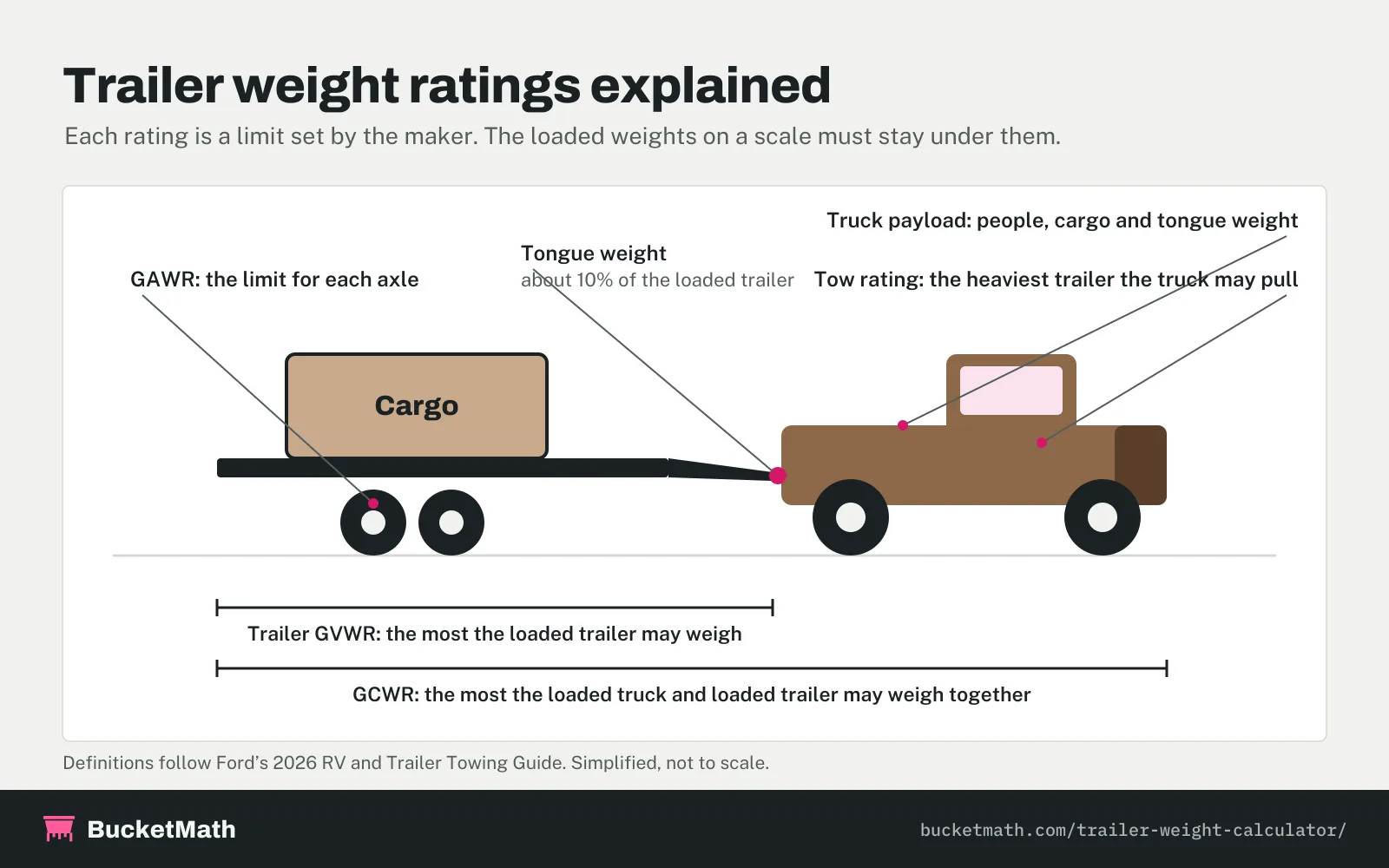
Trailer weight ratings: GVWR, GAWR, GCWR and payload
| Term | What it means | Where to find it |
|---|---|---|
| GVWR | Gross vehicle weight rating: the most a vehicle may weigh fully loaded. A trailer has its own GVWR. | Trailer VIN plate; the label on the truck’s door jamb |
| Empty weight | The trailer as built, with nothing on it. | Maker’s spec sheet, or a scale |
| Cargo capacity | What the trailer can carry: GVWR minus empty weight. | Subtract |
| GAWR | Gross axle weight rating: the most a single axle may carry. | The same plate and label |
| Gross trailer weight | What the loaded trailer actually weighs. | A scale, or empty weight plus cargo |
| Tongue weight | The part of the trailer’s weight that presses down on the hitch. | A tongue scale, or estimate it |
| Tow rating | The heaviest loaded trailer the truck may pull. | Owner’s manual or towing guide |
| GCWR | Gross combination weight rating: the most the loaded truck and loaded trailer may weigh together. | Owner’s manual or towing guide |
For tongue weight, Ford’s 2026 towing guide uses 10 percent of loaded trailer weight for conventional trailers over 2,000 lb and 15 percent king pin weight for fifth-wheel trailers. Ford warns that too little can cut rear-wheel traction and make the trailer unstable. Tongue weight counts as cargo in the truck, so it comes out of the truck’s payload.
How much does a 7,000 lb trailer weigh?
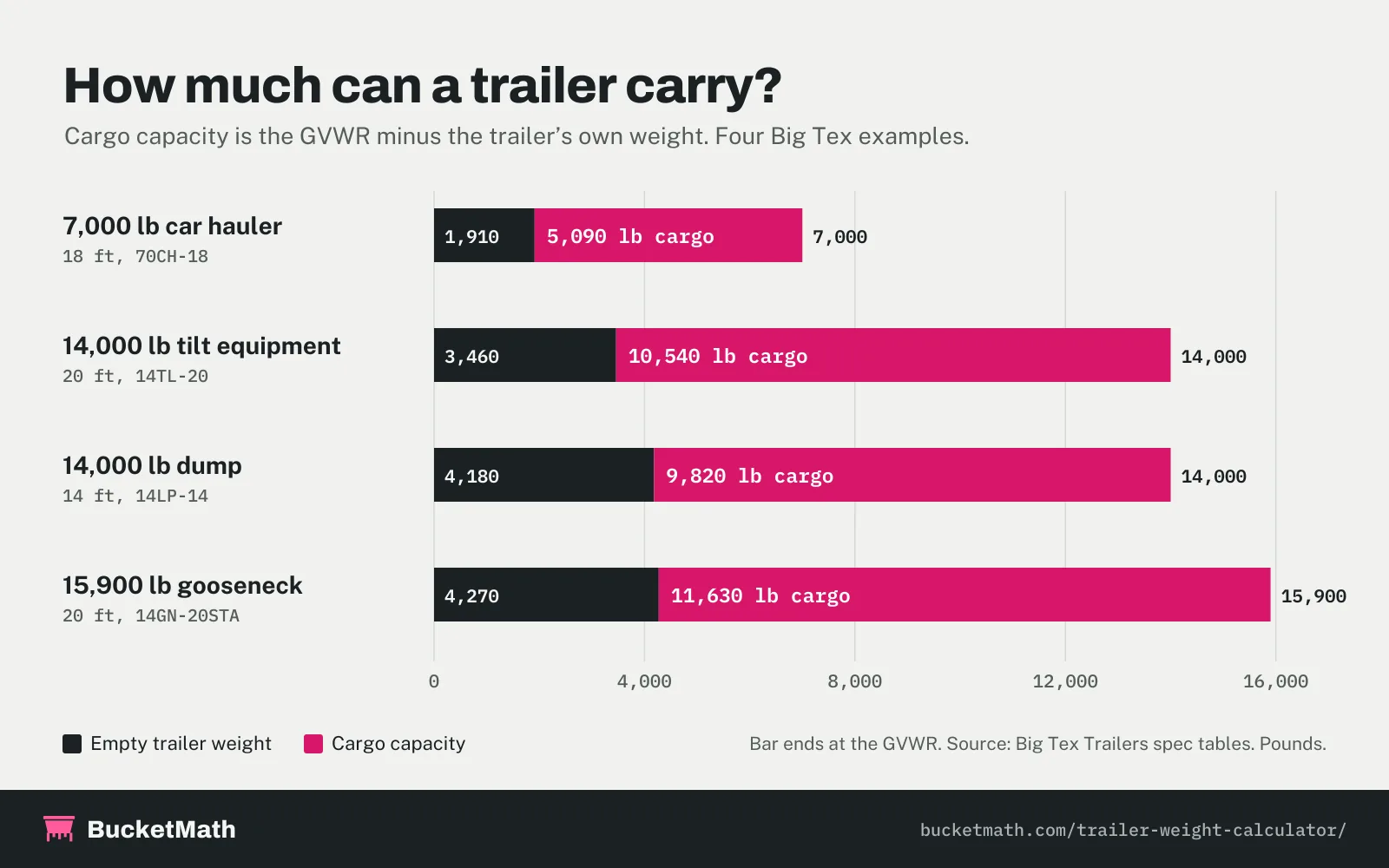
Much less than 7,000 lb. The figure in a trailer’s name is its GVWR, the most it may weigh loaded. Big Tex lists its 7,000 lb car haulers at 1,610 to 2,060 lb empty, which leaves 4,940 to 5,390 lb for cargo.
| Trailer | GVWR | Empty weight | Cargo capacity |
|---|---|---|---|
| Car hauler, 14 ft (70CH-14) | 7,000 lb | 1,610 lb | 5,390 lb |
| Car hauler, 18 ft (70CH-18) | 7,000 lb | 1,910 lb | 5,090 lb |
| Car hauler, 20 ft (70CH-20) | 7,000 lb | 2,060 lb | 4,940 lb |
| Tilt equipment, 20 ft (14TL-20) | 14,000 lb | 3,460 lb | 10,540 lb |
| Tilt equipment, 22 ft (14TL-22) | 14,000 lb | 3,660 lb | 10,340 lb |
| Dump, 12 ft (14LP-12) | 14,000 lb | 3,870 lb | 10,130 lb |
| Dump, 14 ft (14LP-14) | 14,000 lb | 4,180 lb | 9,820 lb |
| Dump, 16 ft (14LP-16) | 14,000 lb | 4,250 lb | 9,750 lb |
| Gooseneck flatbed, 20 ft (14GN-20STA) | 15,900 lb | 4,270 lb | 11,630 lb |
Double axle trailer weight capacity
A tandem (double axle) trailer is rated by its GVWR, and the axles tell you roughly what that will be: two 3,500 lb axles make a 7,000 lb trailer, and two 7,000 lb axles make a 14,000 lb trailer. What it can carry is that rating minus the trailer’s own weight.
| Axles | Example trailer | GVWR | Cargo capacity |
|---|---|---|---|
| 2 × 3,500 lb | Big Tex 70CH car hauler | 7,000 lb | 4,940 to 5,390 lb |
| 2 × 7,000 lb | Big Tex 14TL tilt equipment | 14,000 lb | 10,340 to 10,540 lb |
| 2 × 7,000 lb | Big Tex 14LP dump | 14,000 lb | 9,750 to 10,130 lb |
| 2 × 7,000 lb, gooseneck | Big Tex 14GN flatbed | 15,900 lb | 11,630 lb (20 ft) |
So a trailer with two 3,500 lb axles carries about 5,000 lb, not 7,000. Note the gooseneck: it is rated above its axle total because part of the load rides on the truck through the hitch. Always go by the GVWR on the plate. Our double axle trailer weight capacity guide has the full chart by axle size.
What does 5,000 lb gross trailer weight mean?
It means the trailer and everything on it weigh 5,000 lb together. As a rating, it is the most a hitch or a vehicle may tow. Ford groups trailers into four classes by gross trailer weight:
| Class | Gross trailer weight |
|---|---|
| Class I | Up to 2,000 lb |
| Class II | 2,001 to 3,500 lb |
| Class III | 3,501 to 5,000 lb |
| Class IV | Over 5,000 lb |
The line matters on the truck too. Ford rates the F-150’s hitch receiver for a 5,000 lb trailer and 500 lb of tongue weight as a plain weight-carrying hitch, and up to 13,500 lb and 1,400 lb with a weight-distributing hitch.
Hauling equipment: will it fit the trailer?
Here is the same 14,000 lb, 20 ft tilt trailer (3,460 lb empty) with machines from our spec pages. These are operating weights before any attachments.
| Machine | Weight | Loaded trailer | Against 14,000 lb GVWR |
|---|---|---|---|
| Bobcat E35 excavator | 7,659 lb | 11,119 lb | 2,881 lb to spare |
| Bobcat S650 skid steer | 7,901 lb | 11,361 lb | 2,639 lb to spare |
| Kubota SVL75-3 track loader | 9,190 lb | 12,650 lb | 1,350 lb to spare |
| Kubota KX040-5 excavator | 9,480 lb | 12,940 lb | 1,060 lb to spare |
| Bobcat T770 track loader | 10,515 lb | 13,975 lb | 25 lb to spare |
| Cat 308 CR excavator | 18,610 lb | 22,070 lb | Over by 8,070 lb |
The Bobcat T770 shows why the margin matters: it fits by 25 lb on paper, which disappears with a spare bucket. For that machine you need a trailer with a higher rating.
Material in a dump trailer
For loose material, divide the cargo capacity by the weight of a cubic yard. A 14 ft dump trailer with 9,820 lb of capacity carries:
| Material | Weight per cubic yard | Load that reaches 9,820 lb |
|---|---|---|
| Gravel, dry | 2,835 lb | 3.46 yd³ |
| #57 stone, loose | 2,430 lb | 4.04 yd³ |
| Topsoil (loam) | 2,160 lb | 4.55 yd³ |
| Loose dirt, dry | 2,052 lb | 4.79 yd³ |
Check the weight, not just the volume: 9,820 lb of dry gravel is under 3.5 cubic yards. Work out the cubic yards with the cubic yard calculator, or go straight to tons with the gravel and stone calculators.
Can a 1500 pull an 8,000 lb camper?
A half-ton pickup can, if it is equipped for it, but not every one is. Ford’s 2026 figures for the F-150, its half-ton, show how wide the spread is:
| F-150 engine | Max towing | Max payload |
|---|---|---|
| 2.7L EcoBoost V6 | 8,400 lb | 1,775 lb |
| 3.5L EcoBoost V6 | 13,500 lb | 2,440 lb |
| 3.5L PowerBoost hybrid V6 | 12,400 lb | 1,740 lb |
| 5.0L V8 | 12,800 lb | 2,235 lb |
An 8,000 lb trailer puts about 800 lb on the hitch, which comes out of the payload along with passengers and gear. On an F-150 it is also over the 5,000 lb limit for a plain weight-carrying hitch, so it needs a weight-distributing hitch. The 2.7L truck’s 8,400 lb maximum leaves almost no margin. The same checks apply to a Silverado 1500 or Ram 1500: use the rating for your exact truck from its owner’s manual or towing guide.
When a Class A CDL comes into it
For commercial hauling, federal rules put a truck and trailer in Group A, which needs a Class A CDL, when the gross combination weight rating is 26,001 lb or more and the trailer’s GVWR is over 10,000 lb (49 CFR 383.91). The combination rating can be the sum of the truck’s and trailer’s GVWRs (49 CFR 383.5).
With a 14,000 lb trailer, that line is reached by any truck with a GVWR of 12,001 lb or more. A trailer rated 10,000 lb or less keeps the combination out of Group A. State rules for non-commercial use vary, so check yours.
Before you tow
- Read the GVWR and axle ratings off the trailer’s VIN plate, and the truck’s ratings off its door-jamb label.
- Leave a margin. Published weights do not include attachments, fuel cans, chains or mud.
- Place the load so the hitch carries about 10 percent of the loaded weight on a bumper-pull trailer.
- Check the hitch, the ball and the coupler ratings too. The lowest rating in the chain is the limit.
- Ford’s guide calls for separate trailer brakes on trailers weighing more than 1,500 lb loaded.
- When a number is close, weigh the loaded truck and trailer on a scale.
Frequently asked questions
How to calculate trailer weight?
Add the cargo weight to the trailer’s empty weight. A 3,460 lb trailer carrying a 7,901 lb machine weighs 11,361 lb loaded. Then check that total against the trailer’s GVWR and your truck’s tow rating.
How much does a 7000 lb trailer weigh?
The 7,000 lb is its GVWR, the most it may weigh loaded. Big Tex lists its 7,000 lb car haulers at 1,610 to 2,060 lb empty, leaving 4,940 to 5,390 lb for cargo.
What does 5000 lb gross trailer weight mean?
It means the trailer plus everything on it weighs 5,000 lb. As a rating, it is the heaviest loaded trailer a hitch or vehicle may tow. In Ford’s trailer classes, 5,000 lb is the top of Class III.
Can a 1500 pull a 8000 lb camper?
A properly equipped half-ton can, but many cannot. Ford rates the 2026 F-150 from 8,400 lb with the 2.7L engine to 13,500 lb with the 3.5L EcoBoost. An 8,000 lb trailer also puts about 800 lb on the hitch and needs a weight-distributing hitch on an F-150.
How much weight can a double axle trailer hold?
It depends on the axles and the trailer’s own weight. A tandem trailer with two 3,500 lb axles is rated 7,000 lb and carries about 5,000 lb. One with two 7,000 lb axles is rated 14,000 lb and carries about 10,000 lb.
How much weight can a trailer with two 3,500 lb axles carry?
About 5,000 lb. The trailer is rated 7,000 lb in total, and the trailer itself uses part of that. Big Tex’s 7,000 lb car haulers carry 4,940 to 5,390 lb depending on length.
How much tongue weight should a trailer have?
Ford’s 2026 towing guide uses 10 percent of the loaded trailer weight for conventional trailers over 2,000 lb, and 15 percent king pin weight for fifth-wheel trailers. For a 5,000 lb trailer that is 500 lb.
What is the difference between GVWR and gross trailer weight?
GVWR is a rating: the most the trailer may weigh loaded, set by its maker. Gross trailer weight is what it actually weighs on a scale. The second must never be more than the first.
Sources
- Ford, 2026 RV and Trailer Towing Guide, for weight definitions, tongue weight, trailer classes and F-150 ratings.
- Big Tex Trailers spec tables for the 70CH car hauler, 14TL tilt equipment trailer, 14LP dump trailer and 14GN gooseneck, checked October 7, 2026.
- 49 CFR 383.91 and 49 CFR 383.5, via Cornell Legal Information Institute, for commercial vehicle groups and the GCWR definition.
- Machine weights from our equipment spec pages. Material weights from Engineering ToolBox and the Rohrer’s Quarry figures used in our calculators.
Ford, Big Tex, Bobcat, Cat, Kubota, Chevrolet and Ram are trademarks of their owners. BucketMath is independent and not affiliated with any of them. Towing and licensing information here is general, not legal advice; see our disclaimer.