
Short answer
A skid steer, or skid-steer loader, is a compact loader on four wheels that do not steer. It turns by driving the wheels on one side faster than the other, so the tires skid and the machine can spin within its own length. Lift arms on both sides of the cab carry a bucket or another attachment. Bobcat’s current models run from 23.5 to 115 hp and weigh 2,892 to 10,098 lb.
This guide covers what it is, how it turns, what it is used for, the sizes it comes in, how it differs from a track loader and a Bobcat, whether you need a licence, and what the accident data says.
What is a skid steer?
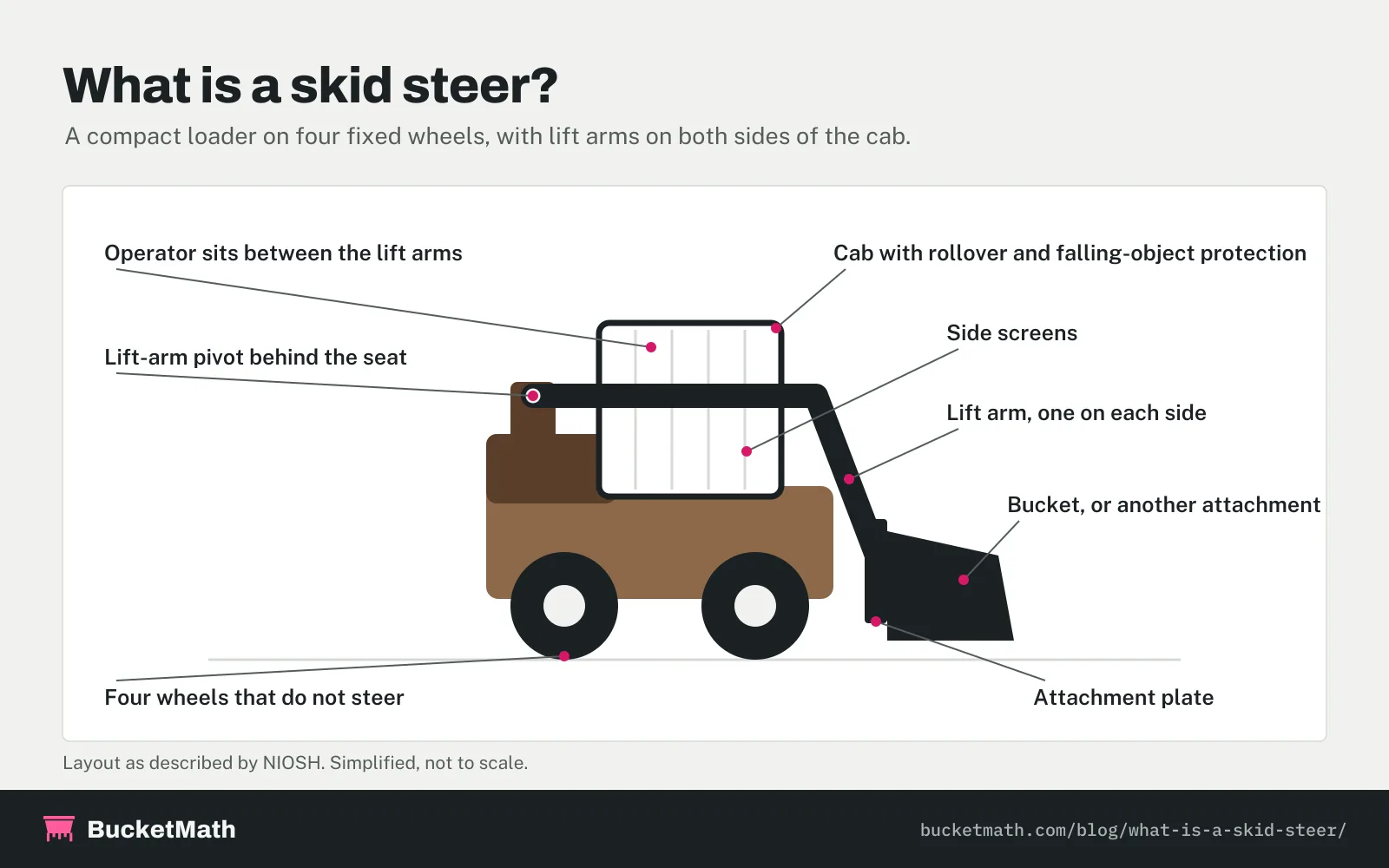
A skid steer is a small loader with fixed wheels. The US safety agency NIOSH describes the usual layout: the operator’s seat sits between two lift arms and in front of the points where they pivot, and the operator climbs in through the front, over the lowered arms and attachment. NIOSH notes that the machines are common in agriculture, construction and general industry for handling material and for excavating.
What is a skid steer also called? Skid-steer loader, skid loader and compact loader all mean the same machine. Many people call any skid steer a “Bobcat”, after the best-known brand.
It is sometimes called a skid steer tractor, but it is a loader, not a tractor. Where a farm tractor uses a hitch and a PTO, a skid steer carries its attachments on a plate at the front of the lift arms and powers them from its auxiliary hydraulics. On the Bobcat S650 that is 23 gpm as standard and 30.5 gpm with the high-flow option.
Why is it called a skid steer?
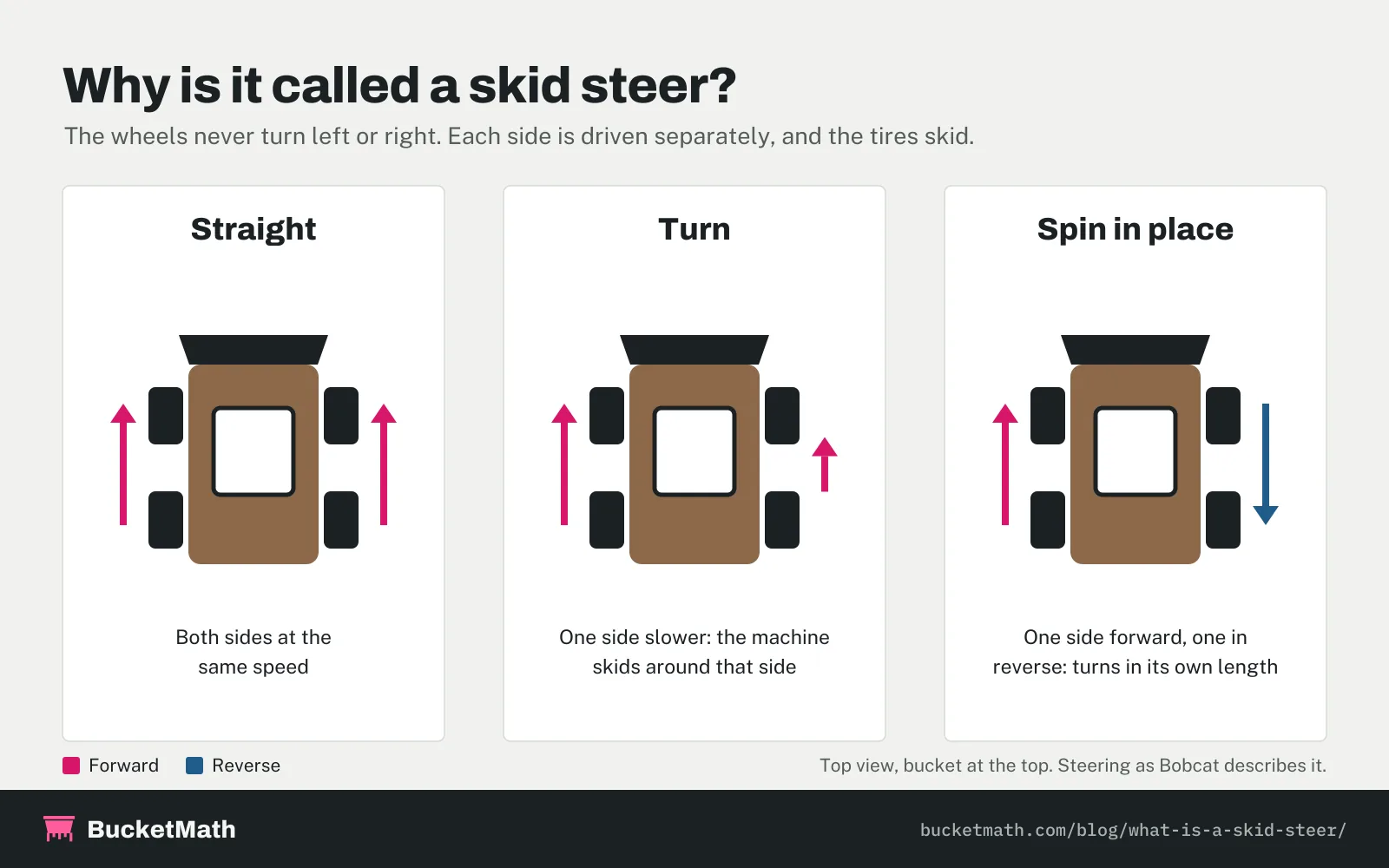
Because that is how it steers. Bobcat explains that a separate hydrostatic drive powers the wheels on each side. Run both sides at the same speed and the machine goes straight. Slow one side, or reverse it, and the machine skids around the slower side. With one side forward and the other in reverse it turns within its own length.
The idea dates from 1957, when brothers Louis and Cyril Keller built a small three-wheeled loader for a Minnesota turkey farmer. According to Bobcat, Melroe Manufacturing took the design on after the 1958 Minnesota State Fair and launched the four-wheel-drive M-400 in 1960, which Bobcat calls the first true skid-steer loader. The Bobcat name followed in 1962.
What is a skid steer used for?
Mostly for loading, carrying and grading material in places too tight for a bigger loader. What makes it so widely used is that the bucket comes off: the same machine runs many different attachments.
| Attachment | Typical job |
|---|---|
| Loader bucket | Scoop, carry and load soil, gravel or mulch, and backfill |
| Pallet forks | Move pallets, lumber and sod |
| Auger | Drill holes for posts and planting |
| Grapple | Grab brush, logs and demolition debris |
| Breaker or hammer | Break up concrete and rock |
| Trencher | Cut narrow trenches for pipe and cable |
| Blade or grading attachment | Level and grade ground |
| Broom or sweeper | Clean pavement and yards |
| Mower, cutter or mulcher | Clear grass, brush and small trees |
| Snow blade, pusher or snowblower | Clear snow from lots, drives and paths |
For snow removal, a skid steer swaps its bucket for a snow blade, a snow pusher or a snowblower. Because it turns within its own length, it can work in tight lots and driveways.
To work out how much material a job needs before you start, use our cubic yard calculator or gravel calculator.
Skid steer sizes
Bobcat sorts its skid steers into three horsepower bands. The small, medium and large labels below are ours; the numbers are Bobcat’s for its current models. Widths run from 35.5 in for the smallest model to about 72 in for the medium and large ones.
| Size | Engine | Rated capacity | Weight |
|---|---|---|---|
| Small | 23.5 to 68 hp | 760 to 2,300 lb | 2,892 to 6,855 lb |
| Medium | 74 hp | 2,400 to 2,900 lb | 7,046 to 8,014 lb |
| Large | 92 to 115 hp | 3,350 to 3,500 lb | 9,154 to 10,098 lb |
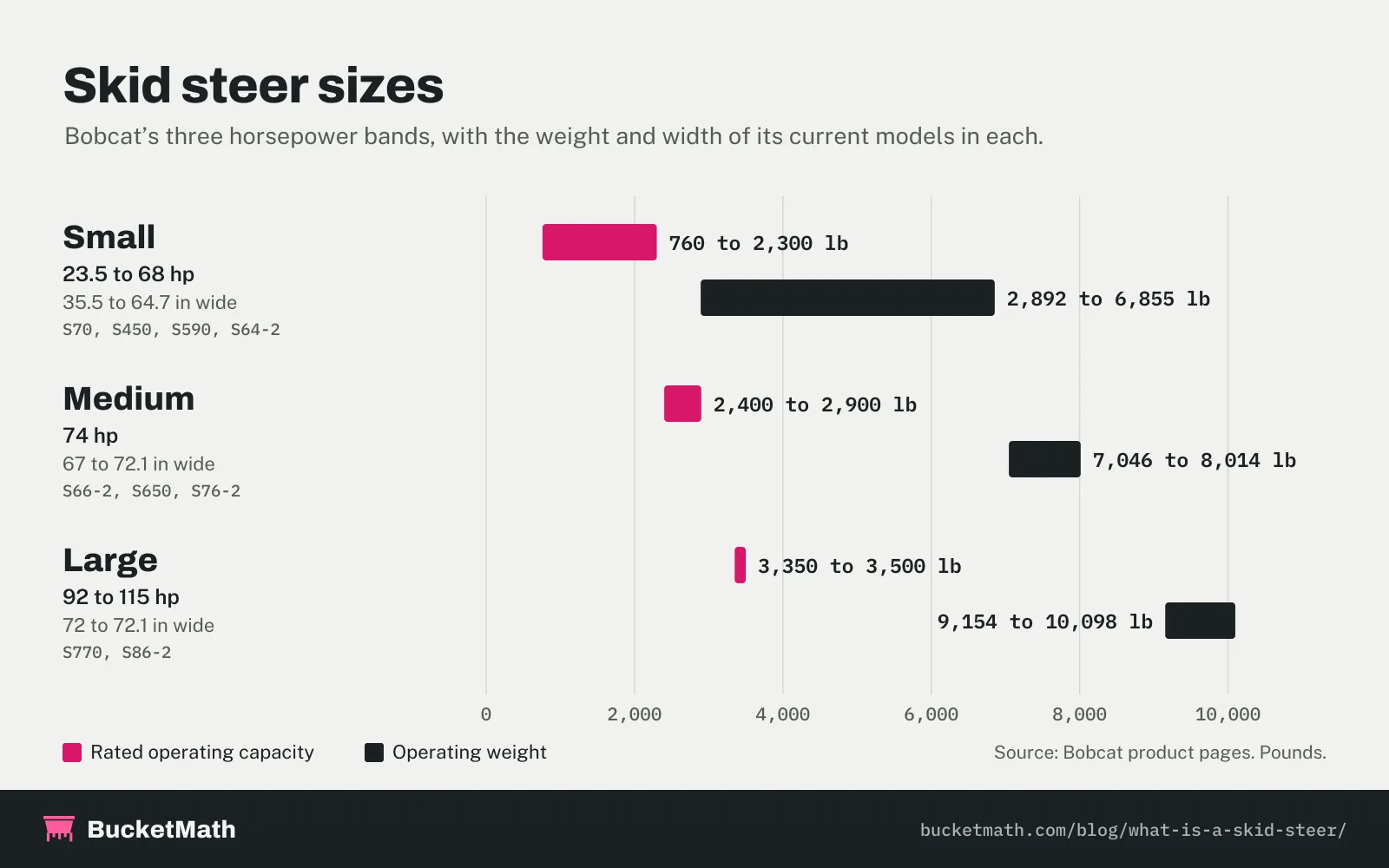
Rated operating capacity is how much the machine is rated to carry. For a wheeled skid steer it is 50 percent of the tipping load under ISO 14397-1: the Bobcat S650 tips at 5,380 lb, so it is rated for 2,690 lb. For model-by-model weights and what they mean for trailers, see how much a skid steer weighs.
Radius lift vs. vertical lift
Skid steers come with one of two lift paths. Bobcat describes a radius (radial) path as giving the most forward reach at mid-height, which suits backfilling, loading flatbed trailers and dumping over low walls. A vertical path keeps the load closer to the machine as it rises and gives more reach at full height, which suits loading high-sided trucks. The S650 is a vertical-lift machine with a 124 in hinge pin height.
What is a skid steer with tracks called?
A compact track loader, or CTL. It has the same layout and takes the same kind of attachments, but runs on rubber tracks instead of wheels. Bobcat’s guide puts the trade-off this way: wheels do well on hard surfaces and travel faster, while tracks spread the weight over a larger footprint and grip better on soft, wet or uneven ground.
| Spec | Bobcat S650 (wheels) | Bobcat T770 (tracks) |
|---|---|---|
| Engine | 74 hp | 92 hp |
| Operating weight | 7,901 lb | 10,515 lb |
| Tipping load | 5,380 lb | 9,929 lb |
| Rated operating capacity | 2,690 lb, at 50% of tipping load | 3,475 lb, at 35% of tipping load |
| Standard auxiliary flow | 23 gpm | 23 gpm |
Because the two types are rated at different percentages, compare tipping loads as well as rated capacities when you cross-shop them. We have full spec pages for the Bobcat T770, Cat 259D3, John Deere 333G and Kubota SVL75 track loaders.
Is a skid steer the same as a loader?
A skid steer is one kind of loader. “Loader” also covers compact track loaders, backhoe loaders and the much larger wheel loaders, which steer their wheels or frame instead of skidding.
| Loader type | How it steers | Example |
|---|---|---|
| Skid steer | Skids its fixed wheels | Bobcat S650, 7,901 lb |
| Compact track loader | Skids its tracks | Bobcat T770, 10,515 lb |
| Backhoe loader | Steers its front wheels | Cat 420, 17,271 lb |
A backhoe loader adds a digging arm at the back. For that comparison, see backhoe vs. excavator.
Skid steer vs. Bobcat
Skid steer is the type of machine. Bobcat is a brand. Melroe adopted the Bobcat name in 1962 for its M-440 loader, and the name became everyday shorthand for the whole category. Cat, Kubota and others build skid steers too: the Cat 226D3 and 262D3 are in our weight comparison.
Can you drive a skid steer without a license?
We found no federal operator’s licence for skid steers in the US. What the OSHA construction rules do is put the duty on the employer: only employees “qualified by training or experience” may operate equipment (29 CFR 1926.20(b)(4)), and each employee must be instructed to recognise and avoid the hazards of the work (29 CFR 1926.21(b)(2)).
So on a job site, expect to be trained and signed off by the employer before you run one. That is also what a skid steer operator is: the person trained and authorised to run the machine. Rules for driving one on a public road, and any state or local licensing, vary, so check with your state. Rental companies set their own conditions.
Skid steer accidents and safety
A NIOSH safety alert reviewed 37 work deaths involving skid steers from 1992 to 1997. In 29 of them (78 percent) the worker was pinned between the bucket and the frame, or between a lift arm and the frame. Six were rollovers. Of the 29 pinning deaths, 10 happened to someone working or standing under a raised arm or attachment with no support device, 8 to an operator leaning out into the path of a moving lift arm, and 5 while getting in or out.
The cause is the layout. Getting in over the front puts the operator in the path of the lift arms. Machines counter this with interlocked controls that stay locked until the seat belt or restraint bar is in place, a cab with rollover and falling-object protection, seat belts and side screens. NIOSH’s advice to operators includes:
- Operate only from the seat, with the seat belt fastened and the restraint bar down.
- Keep hands, arms, legs and head inside the cab while the machine is working.
- Carry the load low, and travel straight up or down a slope with the heavy end uphill.
- Get in and out only with the bucket flat on the ground or the lift-arm support in place.
- Before leaving the seat, lower the bucket flat, set the parking brake and turn off the engine.
- Never bypass a safety device, and never carry riders.
Frequently asked questions
What is a skid steer?
A skid steer is a compact loader on four wheels that do not steer. It turns by driving one side faster than the other so the tires skid. Lift arms on both sides of the cab carry a bucket or another attachment.
Why do they call it a skid steer?
Because it steers by skidding. Each side has its own drive. Slowing or reversing one side makes the machine skid around it, and running the two sides in opposite directions spins it within its own length.
What is a skid steer vs Bobcat?
Skid steer is the type of machine and Bobcat is a brand of it. The Bobcat name was adopted in 1962 and became shorthand for the whole category. Cat, Kubota and others also make skid steers.
Can you drive a skid steer without a license?
We found no federal operator’s licence for skid steers in the US. On construction sites, OSHA rules require employers to let only trained or experienced employees operate equipment. Public road and state rules vary, so check with your state.
Is a skid steer the same as a loader?
A skid steer is one type of loader. The word loader also covers compact track loaders, backhoe loaders and larger wheel loaders, which steer their wheels or frame instead of skidding.
What is a skid steer used for?
Loading, carrying and grading material in tight spaces, plus many other jobs with attachments: pallet forks, augers, grapples, breakers, trenchers, brooms, mowers, and snow blades, pushers and snowblowers.
What is a skid steer with tracks called?
A compact track loader, or CTL. It has the same layout and attachments but runs on rubber tracks, which spread the weight and grip better on soft, wet or uneven ground.
How much does a skid steer weigh?
Bobcat’s current skid steers weigh 2,892 lb for the small S70 up to 10,098 lb for the S86-2. A common 74 hp machine weighs about 7,000 to 8,000 lb.
Sources
- Bobcat, What Is a Skid-Steer Loader and How Does It Work?, March 3, 2026, for steering, lift paths and wheels against tracks.
- Bobcat, Product Timeline, for the Keller brothers, the M-400 and the Bobcat name.
- Bobcat, Attachments, for attachment categories. Model figures are from Bobcat product pages, as listed on our skid steer weight guide.
- NIOSH Alert: Preventing Injuries and Deaths from Skid-Steer Loaders, DHHS (NIOSH) Publication No. 2011-128, December 2010.
- OSHA, 29 CFR 1926.20 and 29 CFR 1926.21.
- Bobcat S650, Bobcat T770 and Cat 420 figures from our spec pages and backhoe vs. excavator guide, which cite each maker.
Bobcat, Cat and Kubota are trademarks of their owners. BucketMath is independent and not affiliated with any of them. This is general information, not safety training or legal advice: follow the operator’s manual and your employer’s rules; see our disclaimer.