
Enter the size and depth of your driveway, path or pad to see how many tons and cubic yards of gravel to order, plus bags, truckloads and cost. Depth presets come from Penn State’s gravel road handbook and the CPSC playground handbook, and the math is shown under the result.
Gravel you need
15.75tons
| Cubic yards | 11.11 yd³ |
| Cubic feet | 300.0 ft³ |
| Metric | 8.50 m³, 14.29 t |
| Weight | 31,500 lb (1.42 tons per yd³) |
| Bags | 600 bags of 0.5 cu ft |
| Truckloads | 2 (at 15 tons per load) |
| Cost | Enter a price |
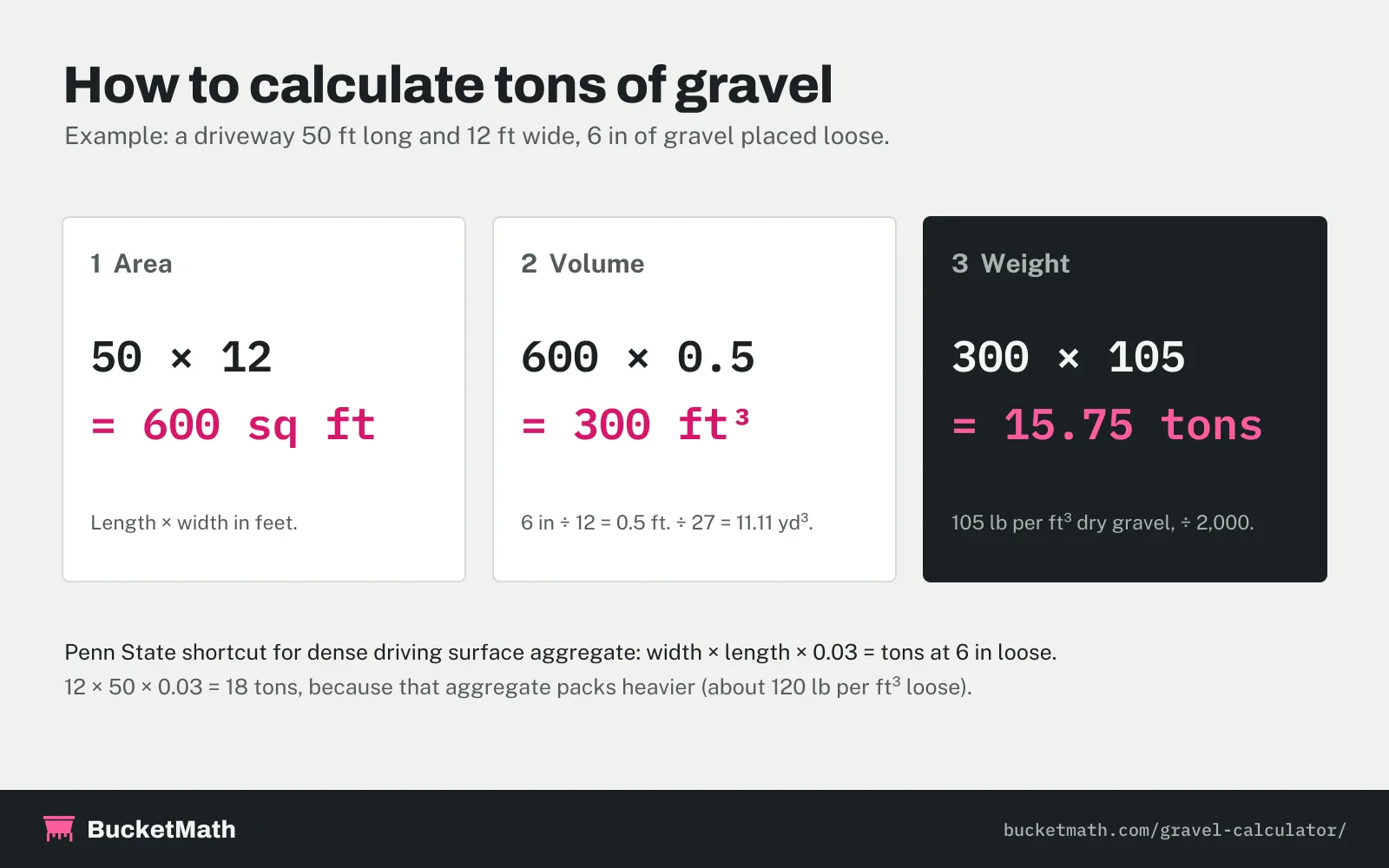
Area: 50 ft × 12 ft = 600.0 sq ft. Depth: 6 in ÷ 12 = 0.5 ft. 600.0 × 0.5 = 300.0 ft³ ÷ 27 = 11.11 yd³. 300.0 ft³ × 105 lb = 31,500 lb ÷ 2,000 = 15.75 tons.
Estimate based on your inputs and the assumptions on this page. Disclaimer
How to calculate how much gravel you need
Gravel is sold by the ton, so work out the volume first and then convert it to weight: tons = length (ft) × width (ft) × depth (ft) × density (lb per ft³) ÷ 2,000.
- Multiply length × width in feet to get square feet.
- Divide the depth in inches by 12 and multiply to get cubic feet. Divide by 27 for cubic yards.
- Multiply cubic feet by the stone’s density. Dry gravel is about 105 lb per cubic foot.
- Divide pounds by 2,000 to get US tons.
- If your depth is the finished, compacted depth, divide it by 0.75 first to get the loose depth to order.
| Area | 2 in | 3 in | 4 in | 6 in |
|---|---|---|---|---|
| 100 sq ft | 0.88 | 1.31 | 1.75 | 2.63 |
| 250 sq ft | 2.19 | 3.28 | 4.38 | 6.56 |
| 500 sq ft | 4.38 | 6.56 | 8.75 | 13.13 |
| 1,000 sq ft | 8.75 | 13.13 | 17.50 | 26.25 |
| 2,000 sq ft | 17.50 | 26.25 | 35.00 | 52.50 |
How deep should gravel be?
Loose gravel settles when it is compacted or used, so sources give two depths: what you place and what you end up with. Both sources below lose about a quarter of the depth, which is why the calculator divides a finished depth by 0.75.
| Project | Place (loose) | Ends up | Source |
|---|---|---|---|
| Gravel road or driveway surface | 6 in | about 4 1/2 in | Penn State DSA Handbook |
| Heavier gravel road or driveway surface | 8 in | 6 in | Penn State DSA Handbook |
| Playground pea gravel (falls up to 5 ft) | 12 in | 9 in | CPSC Playground Safety Handbook |
Penn State’s handbook warns that placing less than 6 in loose may not leave enough material to compact properly, and more than 8 in may not reach full density with a 10-ton roller. The CPSC says never to let playground pea gravel drop below 9 in.
How much gravel for a driveway?
Penn State gives a shortcut for its driving surface aggregate: tons = width × length × 0.03 for a 6 in loose lift, or × 0.04 for an 8 in lift.
| Driveway 12 × 50 ft | Volume | Dry gravel | Penn State DSA |
|---|---|---|---|
| 6 in loose | 11.11 yd³ | 15.75 tons | 18 tons |
| 8 in loose | 14.81 yd³ | 21.00 tons | 24 tons |
The two answers differ because driving surface aggregate is a dense blend with fines that packs heavier than plain gravel. That is the practical lesson: tons depend on the stone, so ask your supplier what one cubic yard of their material weighs and enter it under My supplier’s figure.
How many tons of gravel are in a cubic yard?
About 1.42 tons for dry gravel and 1.69 tons wet, from Engineering ToolBox densities of 105 and 125 lb per cubic foot. HomeGuide puts one cubic yard at 1.4 to 1.5 tons of stone.
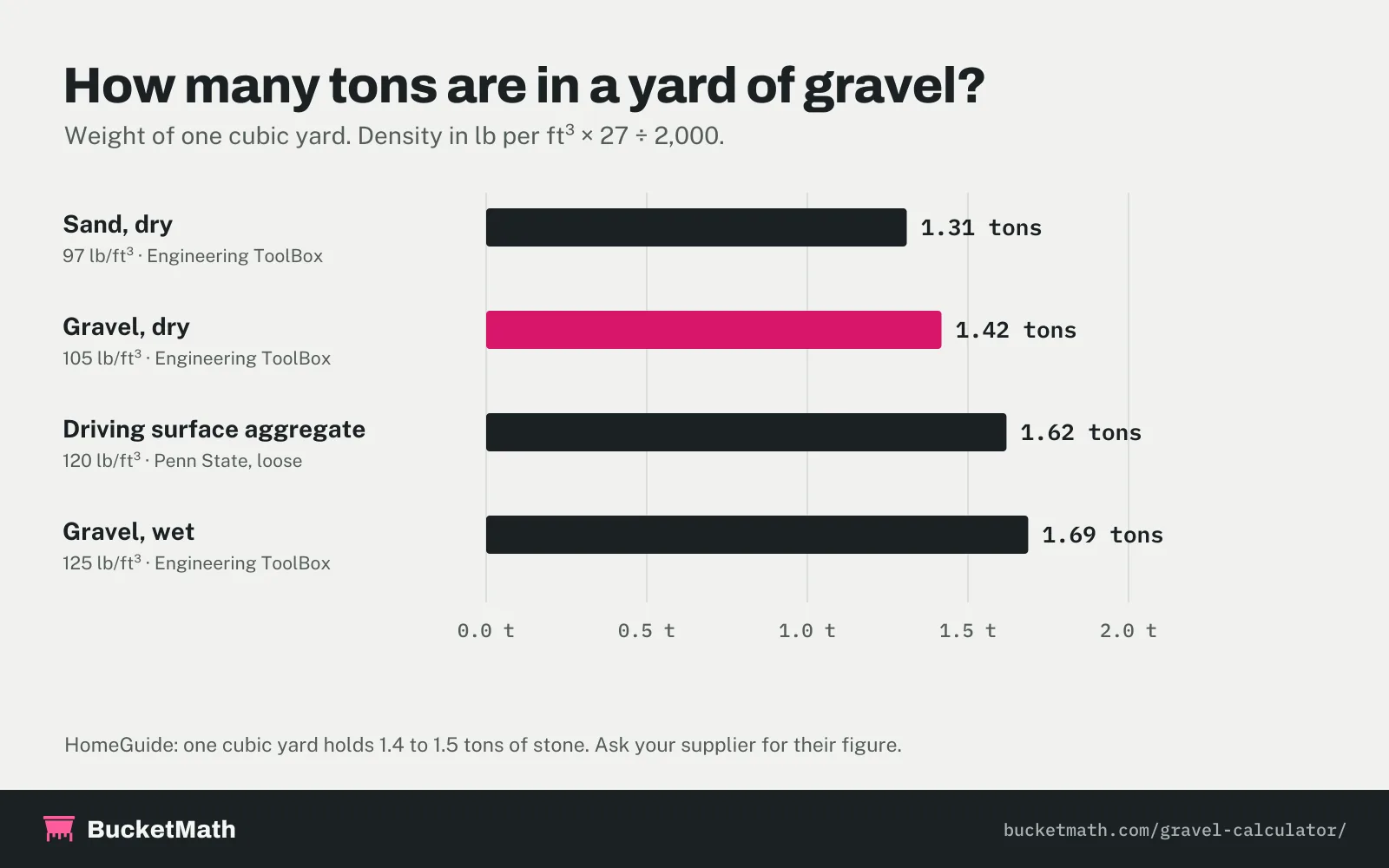
| Material | lb per ft³ | Tons per yd³ |
|---|---|---|
| Sand, dry | 97 | 1.31 |
| Gravel, dry | 105 | 1.42 |
| Driving surface aggregate, loose | 120 | 1.62 |
| Gravel, wet | 125 | 1.69 |
How much does a ton of gravel cover?
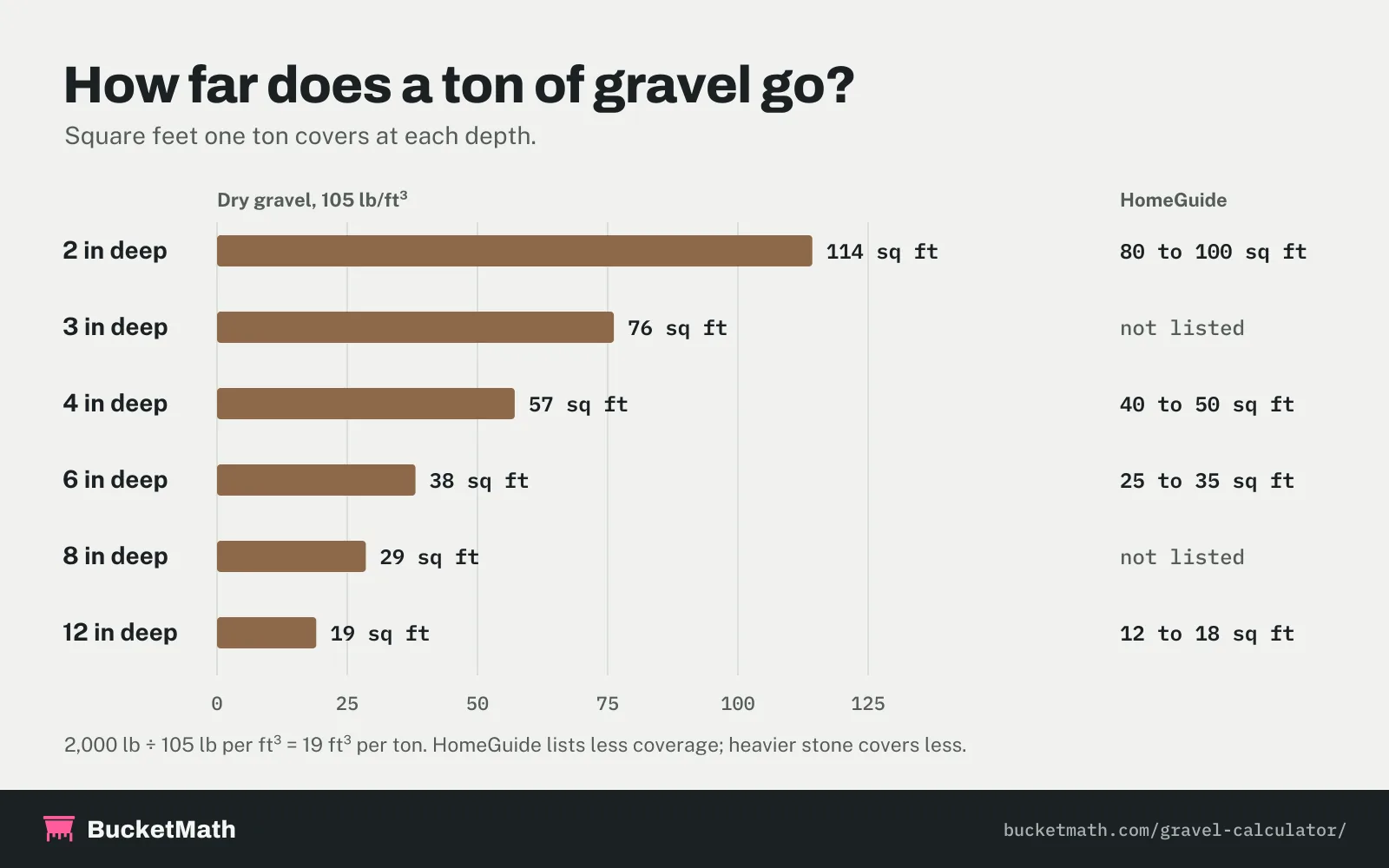
One ton of dry gravel is about 19 cubic feet (2,000 ÷ 105), so it covers about 114 sq ft at 2 in deep, 57 sq ft at 4 in and 38 sq ft at 6 in. HomeGuide lists a little less, 80 to 100 sq ft at 2 in, because heavier stone fills less space per ton.
Gravel types and sizes
“Clean” stone has the fines washed out, so water drains through it. Stone graded “to fine” includes dust that fills the gaps and packs hard, which suits driving surfaces. Sizes and uses below are from Penn State’s Road Aggregates 101 chart for Pennsylvania, plus HomeGuide for pea gravel and crusher run. For crushed stone sold by size number, such as #57, 2B or ABC, use the stone calculator.
| Name | Size | Common use |
|---|---|---|
| AASHTO #57 (PA 2B) | 1.5 in to 3/32 in, clean | Buried drains |
| AASHTO #8 (PA 1B) | 1/2 in to 3/32 in, clean | Chip surfacing |
| AASHTO #3 (PA 3A) | 2.5 in to 1/2 in, clean | Haul road surface, choke |
| AASHTO #1 (ballast) | 4 in to 3/4 in, clean | Road base, buried drains |
| #10 screenings | Less than 3/8 in | Trail surface, anti-skid |
| PennDOT 2A | 2 in to fine | Road base, road surface |
| Driving surface aggregate (DSA) | 1.5 in to fine | Unbound road surface |
| Pea gravel | About 3/8 in, smooth | Landscaping, playground loose-fill |
| Crusher run (quarry process, No. 411) | Crushed stone with stone dust | Compacted base and driveways |
How much does gravel cost?
HomeGuide’s December 2025 guide puts bulk gravel at $10 to $50 per ton, or $15 to $75 per cubic yard. Delivery is about $10 to $25 per ton, and some suppliers deliver free within 5 miles on a 5-ton minimum.
| Type | Price |
|---|---|
| Class 5 (sand and gravel mix) | $11 to $19 per ton |
| Road base (3/4 in minus) | $18 to $31 per ton |
| Crusher run | $24 to $34 per ton |
| Pea gravel | $28 per ton for 24+ tons, $45 per ton for less |
| Crushed limestone | $30 to $38 per ton |
| Bagged pea gravel or crushed stone | $2 to $6 per bag (2 cu ft or less) |
Example: the 50 × 12 ft driveway at 6 in needs about 15.75 tons. Crusher run at $24 to $34 per ton is about $378 to $536 before delivery. HomeGuide says a 10-wheel dump truck carries 12 to 20 tons, so this is a single load at the high end or two smaller ones.
Before you order
- Ask the supplier for the weight of one cubic yard of the exact stone you are buying, and whether they sell by the ton or the yard.
- Decide whether your depth is loose or finished. Compacted layers need about a third more stone than the finished depth suggests.
- Check that a loaded dump truck can reach the drop spot without damaging a septic field or a paved drive.
- Call 811 a few days before you dig out a driveway or path so buried utility lines can be marked. The service is free.
- Digging out first? Use the Dirt Calculator for the soil you remove.
Frequently asked questions
How much gravel do I need for a 12 × 50 ft driveway?
At 6 in loose, 12 × 50 × 0.5 = 300 cubic feet, or 11.11 cubic yards. That is about 15.75 tons of dry gravel at 105 lb per cubic foot. Penn State’s formula for dense driving surface aggregate gives 18 tons.
How many tons of gravel are in a cubic yard?
About 1.42 tons of dry gravel and 1.69 tons of wet gravel, based on Engineering ToolBox densities. HomeGuide lists 1.4 to 1.5 tons of stone per cubic yard.
How much area does a ton of gravel cover?
About 114 sq ft at 2 in deep, 57 sq ft at 4 in and 38 sq ft at 6 in for dry gravel at 105 lb per cubic foot. HomeGuide lists 80 to 100, 40 to 50 and 25 to 35 sq ft for the same depths.
How deep should driveway gravel be?
Penn State’s handbook places driving surface aggregate 6 to 8 in loose, which compacts to about 4 1/2 to 6 in. Less than 6 in loose may not compact properly.
How much pea gravel do I need for a playground?
The CPSC says to install 12 in of pea gravel, which compresses to 9 in and protects falls up to 5 ft. A 20 × 20 ft area at 12 in is 400 cubic feet, 14.81 cubic yards or about 21 tons.
How many bags of gravel make a yard?
54 bags of 0.5 cubic feet, 27 bags of 1 cubic foot, or 14 bags of 2 cubic feet (13.5 rounded up).
How much does gravel cost?
HomeGuide lists $10 to $50 per ton or $15 to $75 per cubic yard for bulk gravel, plus about $10 to $25 per ton for delivery.
Sources
- Penn State Center for Dirt and Gravel Road Studies, Driving Surface Aggregate (DSA) Handbook, April 2025, including Appendix F, Road Aggregates 101.
- U.S. Consumer Product Safety Commission, Public Playground Safety Handbook (Publication 325), July 2025, Table 2.
- Engineering ToolBox, Dirt and Mud Densities.
- HomeGuide, How Much Does Crushed Stone or Gravel Cost?, by Sarah Noel, December 19, 2025.
- Unit conversions: 1 cubic yard = 27 cubic feet = 0.7646 cubic meters; 1 US ton = 2,000 lb = 0.9072 metric tonnes.