
Short answer
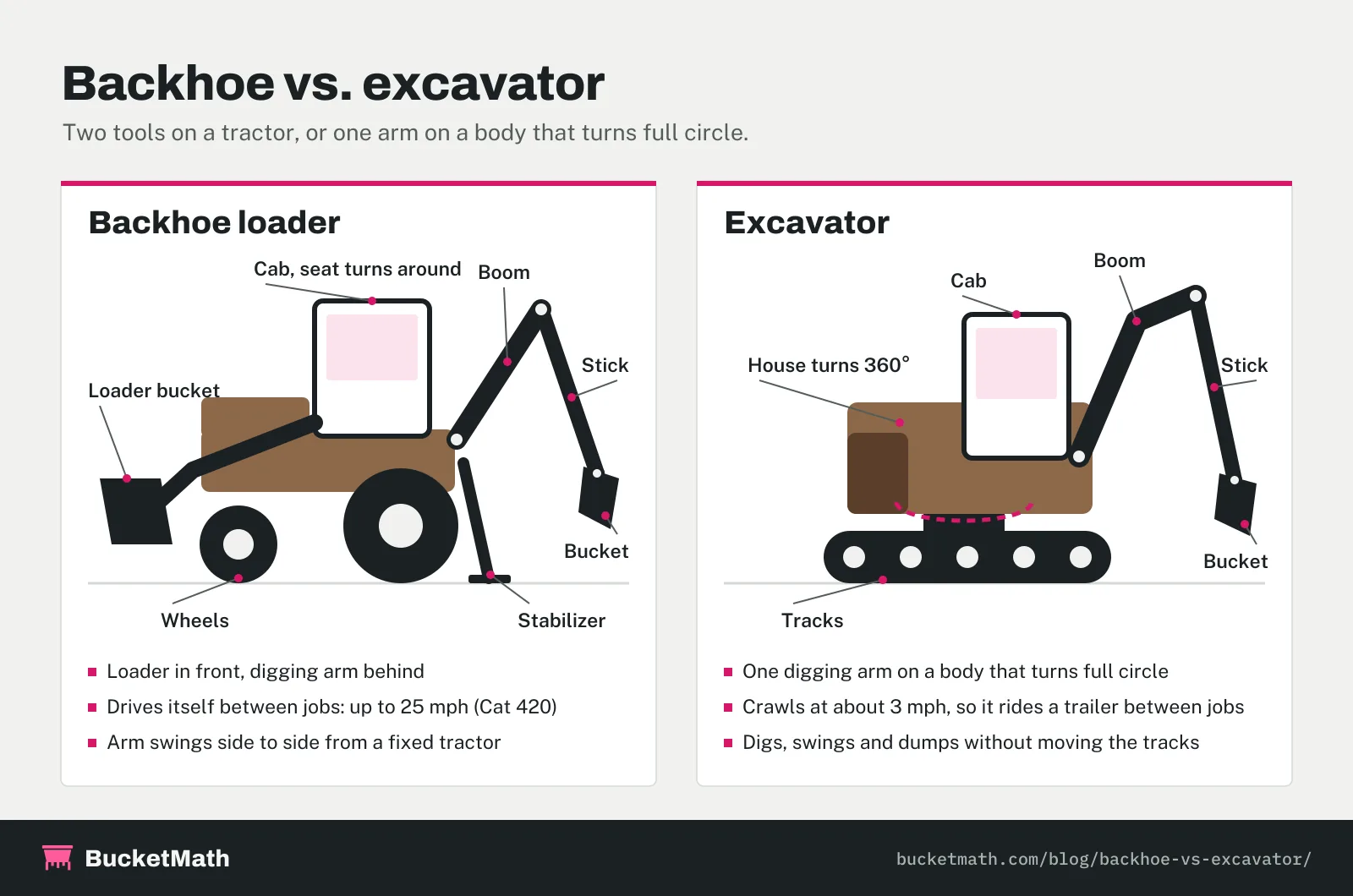
A backhoe loader is a wheeled tractor with a loader bucket on the front and a digging arm on the back. An excavator is one digging arm on a body that turns a full 360° on tracks or wheels. At a similar weight they dig to a similar depth: Cat’s 420 backhoe reaches 14 ft and its 308 CR excavator 13 ft 5.7 in. The backhoe drives itself at up to 25 mph and can load with its front bucket. The excavator digs, swings and dumps in any direction without moving.
People use the two words for the same thing, but they are different machines built on different ideas. Below are the differences that matter on a job, real specs for two matched pairs, how the controls differ, and what each type costs.
Backhoe vs. excavator: the differences at a glance
| Backhoe loader | Excavator | |
|---|---|---|
| Built on | A wheeled tractor chassis with front-wheel steering | Tracks, or sometimes wheels, under a rotating upper body |
| Work tools | A loader on the front and a backhoe arm on the back | One boom, stick and bucket. Compact models such as the Kubota KX040-5 and Cat 308 CR add a dozer blade |
| Rotation | The arm swings side to side behind a fixed tractor, and the operator turns the seat to switch ends | The whole upper body turns 360° |
| Travel speed | Up to 25 mph (Cat 420), 14 mph (Kubota L47) | About 3 mph: 3.2 mph (Cat 308 CR), 3.1 mph (Kubota KX040-5) |
| Loading and carrying | Yes. The Cat 420 carries a 1.25 yd³ loader bucket, and the Kubota M62 loader lifts 3,960 lb | No loader. It loads with the digging bucket |
| Steadying itself | Stabilizer legs at the rear | Its own tracks, plus the blade on compact models |
| Size range | From the 23.3 hp Kubota B26 to machines like the 91 hp (net) Cat 420 | From mini excavators to machines like the 49,800 lb Cat 320, and larger |
| Tractor features | Kubota’s backhoe tractors have a PTO and a three-point hitch | None |
What is a backhoe?
Strictly, the backhoe is the digging arm. The machine most people mean is the backhoe loader, also sold as a tractor-loader-backhoe or TLB: a tractor with a loader in front and that arm behind.
The Cat 420 is a typical full-size example. Cat lists a 102 hp gross (91 hp net) engine, a 14 ft dig depth with the standard stick, a 1.25 yd³ general purpose loader bucket and a top speed of 25 mph. Its estimated operating weight is 17,271 lb in Cat’s listed build, with a maximum of 24,251 lb. Cat points to the legroom for rotating the seat between the two ends, and lists stabilizers, an extendible stick option and a swing lock for transport.
Smaller backhoes are compact tractors. Kubota sells three: the 23.3 hp B26, the 47.1 hp L47 and the 63 hp M62. The L47 digs 121 in (10 ft 1 in) and weighs 7,205 lb with its loader and backhoe. The M62 digs 169.8 in (14 ft 1.8 in) and its loader lifts 3,960 lb. All three have four-wheel drive, a PTO and a Category I three-point hitch, and Kubota lists the L47’s backhoe as quick-mount.
What is an excavator?
An excavator has one job, and it is built around it: a boom, stick and bucket mounted on an upper body (the house) that turns all the way around on its undercarriage. The operator can dig in front, swing and dump behind without moving the machine.
Sizes run from compact machines to very large ones. On our spec pages, the Kubota KX040-5 weighs 9,480 lb and digs 11 ft 2.3 in, the Cat 308 CR weighs 18,610 lb and digs 13 ft 5.7 in, and the Cat 320 weighs 49,800 lb and digs 21 ft 9 in.
What are the two main types of excavators?
Crawler (tracked) and wheeled. Cat sells both: it describes tracked excavators as stable and suited to rough terrain, and its wheeled M-series as faster on pavement, easier on finished surfaces and less dependent on a lowboy trailer between nearby jobs. Makers also sort excavators by size, from mini to large.
Backhoe vs. excavator specs: two matched pairs
Comparing a backhoe and an excavator from the same maker and of similar size shows the real trade-offs.
| Spec | Cat 420 backhoe | Cat 308 CR excavator |
|---|---|---|
| Operating weight | 17,271 lb (estimated, Cat’s listed build) | 18,610 lb (minimum, with cab) |
| Net power | 91 hp | 69.5 hp |
| Max dig depth, standard stick | 14 ft (4,278 mm) | 13 ft 5.7 in (4,108 mm) |
| Top travel speed | 25 mph | 3.2 mph |
| Swing | Arm swings side to side at the rear | 360°, at 10.6 rpm |
| Pump flow | 49.4 gpm | 44 gpm |
| Loader | 1.25 yd³ bucket | None (dozer blade) |
| Spec | Kubota L47 backhoe | Kubota KX040-5 excavator |
|---|---|---|
| Weight | 7,205 lb with loader and backhoe | 9,182 to 10,417 lb |
| Gross power | 47.1 hp | 40.3 hp |
| Max dig depth | 121 in (10 ft 1 in) | 134.3 in (11 ft 2.3 in) |
| Top travel speed | 14 mph | 3.1 mph |
| Loader lift capacity | 2,848 lb | None |
| PTO and three-point hitch | 33 hp PTO, 2,756 lb hitch | None |
| Overall width | 72.5 in | 66.9 in with the standard blade |
| Transport length | 233.9 in (19 ft 5.9 in) | 200.2 in (16 ft 8.2 in) |
| List price, as low as | $72,996 | $68,768 |
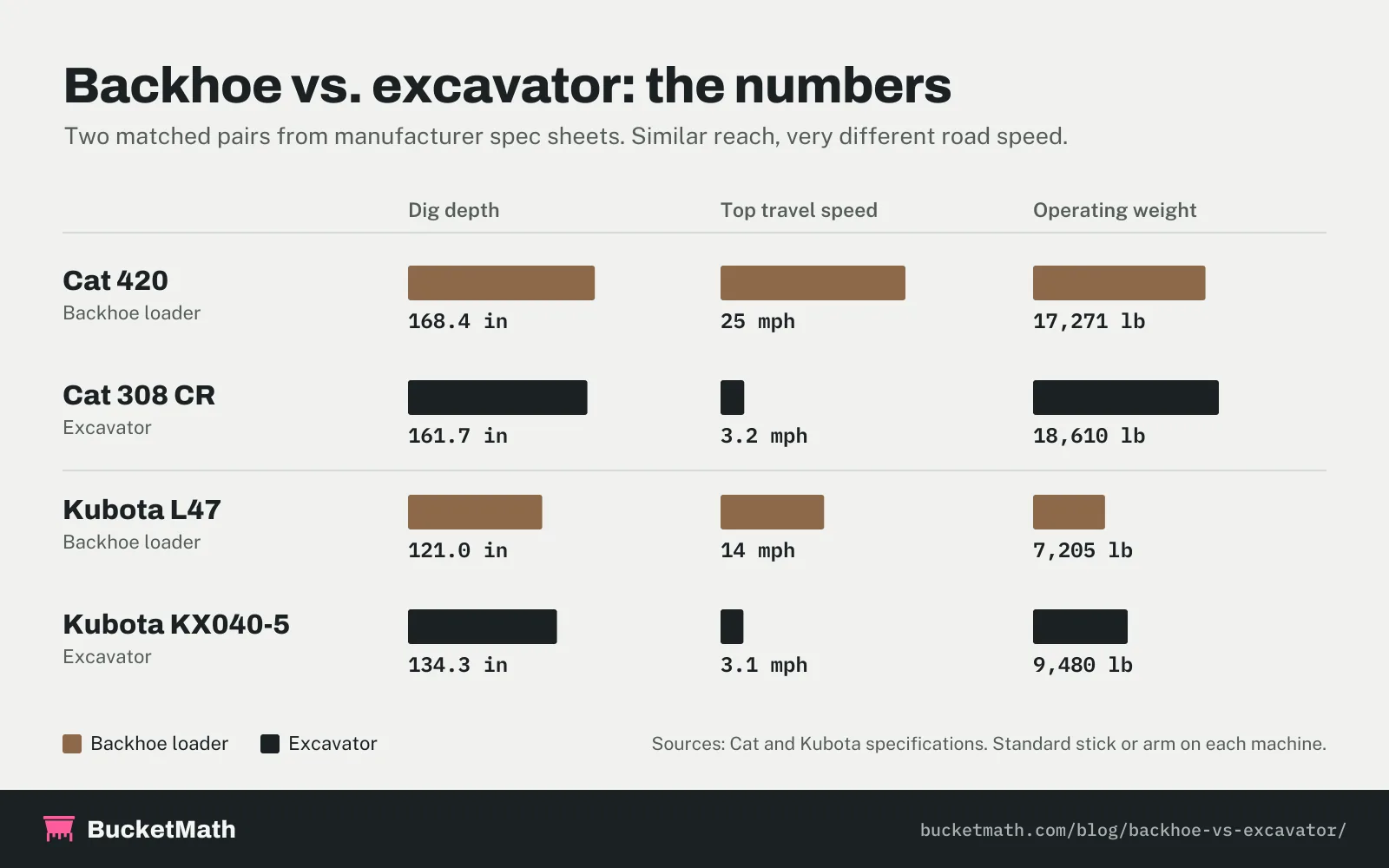
In the Cat pair, dig depth is within 7 in and weight within 1,400 lb. The gap is in travel: 25 mph against 3.2 mph. In the Kubota pair the excavator digs 13.3 in deeper, while the backhoe adds a loader, a PTO and a hitch and travels more than four times as fast.
Backhoe vs. excavator controls
Both machines dig with two joysticks. What differs is the pattern: which hand moves the boom and which moves the stick. Swing stays on the left hand and the bucket on the right in both.
| Joystick movement | Excavator pattern (ISO) | Backhoe pattern (SAE) |
|---|---|---|
| Left joystick, forward and back | Stick | Boom |
| Left joystick, left and right | Swing | Swing |
| Right joystick, forward and back | Boom | Stick |
| Right joystick, left and right | Bucket | Bucket |
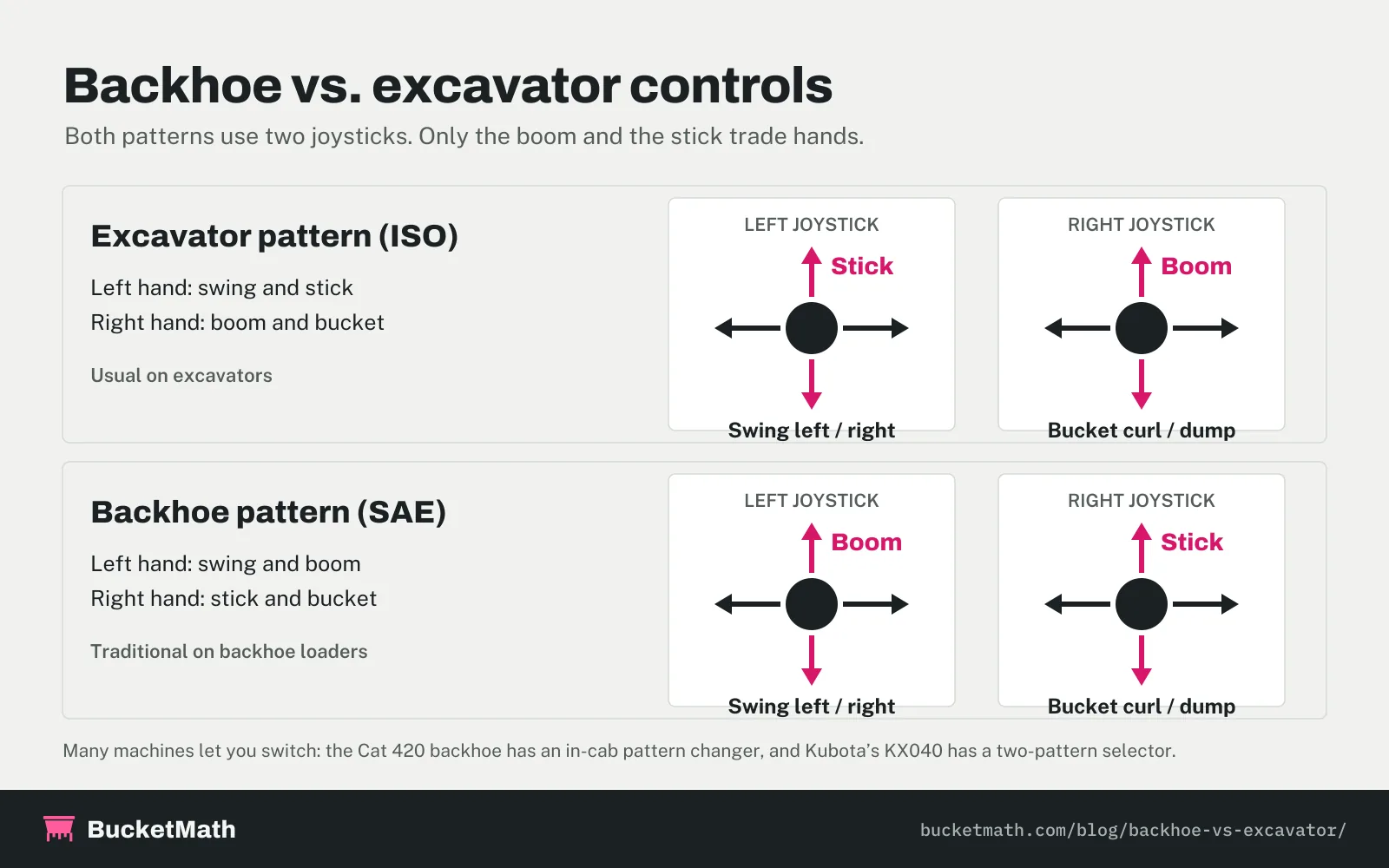
Backhoe mode vs. excavator mode on a machine means this pattern switch. Cat lists pilot joysticks that are “excavator-style with pattern changer”, plus an in-cab pattern changer, as standard on the 420 backhoe. Kubota’s KX040-4 brochure describes a switch under the seat that selects between “the ISO pattern and the SAE backhoe pattern”. Check which pattern a machine is set to before you dig with it.
The other difference is the seat. A backhoe has two working positions: facing forward with a steering wheel and loader lever, and facing back with the digging controls. An excavator has one: two joysticks, with travel levers and pedals in front of them.
Which one do you need?
- You also need to load, carry or backfill: a backhoe has the front bucket for it. An excavator loads only with its digging bucket.
- The machine has to get between sites on its own: a backhoe drives at 14 to 25 mph. An excavator at about 3 mph goes on a trailer, so check its weight against your truck and trailer first. Our trailer and towing math works the same way.
- Digging is the main job: an excavator digs, swings and dumps through a full circle from one spot, and the type goes far beyond backhoe sizes. The Cat 320 digs 21 ft 9 in.
- The site is tight: compare footprints. The Kubota KX040-5 is 66.9 in wide and its tail turns within a 4 ft 3.2 in radius. The L47 backhoe is 72.5 in wide and 19 ft 5.9 in long in transport.
- The ground is soft or finished: tracks spread the weight. Kubota lists 4.5 to 5.1 psi of ground pressure for the KX040-5.
To size the dig itself, use our trench calculator or excavation cost calculator.
Is a backhoe better for farm use than a mini excavator?
If one machine has to do tractor work as well, yes. Kubota’s backhoes are tractors: they have a PTO, a Category I three-point hitch rated at 2,756 lb on the L47 and M62, and a front loader, and Kubota lists the L47’s backhoe as quick-mount. A mini excavator has none of that.
If the work is mostly digging, the mini excavator is the stronger digger for its size. The KX040-5 reaches 134.3 in against the L47’s 121 in, turns 360° and runs on tracks. Their list prices are close: $72,996 for the L47 and $68,768 for the KX040-5. So the real question is how much of the work is digging and how much is everything else.
Are backhoes obsolete?
No. Cat and Kubota both list backhoes in their current ranges, with current prices. What has changed is how many are sold.
Writing in June 2023, Chris Sleight of Off-Highway Research put North American backhoe loader sales at 25,000 to 30,000 a year in the 1990s, when only about 4,000 mini excavators were sold. By 2023 backhoe sales had been under 10,000 a year for three years, while 65,000 mini excavators were sold in each of 2021 and 2022. He ties the shift to the mini excavator’s smaller footprint, 360° swing and lower purchase price.
Backhoe vs. excavator vs. bulldozer, loader and skid steer
| Machine | What it is built to do |
|---|---|
| Backhoe loader | Dig with the rear arm, and load or carry with the front bucket |
| Excavator | Dig, lift and load with one arm that swings 360° |
| Bulldozer | Push and grade soil with a wide front blade, usually on tracks |
| Wheel loader | Scoop, carry and load loose material with a large front bucket |
| Skid steer or compact track loader | A small loader that turns by driving its two sides at different speeds and runs many attachments. The Bobcat S650 is rated to carry 2,690 lb |
Of the five, only the backhoe comes with both a digging arm and a front loader bucket. See all our equipment specs for the machines we have covered.
Backhoe vs. excavator price
Kubota publishes list prices for both types, so its range gives a like-for-like view. These are “MSRP as low as” figures from kubotausa.com, checked October 6, 2026. Options add to them and dealers set their own prices.
| Model | Type | Gross power | List price |
|---|---|---|---|
| Kubota B26 | Backhoe | 23.3 hp | $54,109 |
| Kubota L47 | Backhoe | 47.1 hp | $72,996 |
| Kubota M62 | Backhoe | 63 hp | $91,323 |
| Kubota KX040-4 | Excavator | 40.4 hp | $64,946 |
| Kubota KX040-5 | Excavator | 40.3 hp | $68,768 |
| Kubota KX057-5 | Excavator | 47.6 hp | $88,140 |
At about 47 hp, the L47 backhoe lists $15,144 below the KX057-5 excavator. We have not compared rental rates, which vary by region and season.
Frequently asked questions
What is the difference between a backhoe and an excavator?
A backhoe loader is a wheeled tractor with a loader bucket on the front and a digging arm on the back. An excavator is one digging arm on a body that turns 360° on tracks or wheels. The backhoe can load and drive between jobs; the excavator digs in any direction without moving.
Are backhoes obsolete?
No. Cat and Kubota still list them. But Off-Highway Research reported in 2023 that North American backhoe loader sales had fallen from 25,000 to 30,000 a year in the 1990s to under 10,000, while mini excavator sales reached 65,000 a year.
What are the two main types of excavators?
Crawler (tracked) and wheeled. Tracked excavators are stable on rough ground. Wheeled excavators are faster on pavement and easier on finished surfaces. Makers also group them by size, from mini to large.
What is the difference between backhoe and excavator mode?
It is the joystick pattern. In excavator (ISO) mode the left hand runs swing and stick and the right runs boom and bucket. In backhoe (SAE) mode the boom moves to the left hand and the stick to the right. Many machines have a pattern changer to switch.
Is a backhoe better for farm use than a mini excavator?
If the machine must also do tractor work, yes: Kubota’s backhoe tractors have a PTO, a three-point hitch and a front loader. If the work is mostly digging, a mini excavator digs deeper for its size and turns 360°.
Which digs deeper, a backhoe or an excavator?
At a similar size they are close. The Cat 420 backhoe digs 14 ft and the Cat 308 CR excavator 13 ft 5.7 in. Among compact Kubotas, the KX040-5 excavator digs 134.3 in against 121 in for the L47 backhoe. Excavators are also made far larger.
How fast can a backhoe travel?
Cat lists a top speed of 25 mph for the 420 backhoe loader, and Kubota lists 14 mph for the L47. Excavators crawl at about 3 mph: 3.2 mph for the Cat 308 CR and 3.1 mph for the Kubota KX040-5.
Is a backhoe cheaper than an excavator?
It depends on size. Kubota lists its 47.1 hp L47 backhoe from $72,996, its 40.3 hp KX040-5 excavator from $68,768 and its 47.6 hp KX057-5 excavator from $88,140, as of October 6, 2026.
Sources
- Caterpillar, 420 Center-Pivot Backhoe Loader, specifications and standard equipment, checked October 6, 2026.
- Kubota USA, TLB Series and Kubota L47 competitive comparison sheet, for backhoe specifications and list prices.
- Kubota USA, KX Series, for excavator list prices, and the Kubota KX040-4 brochure for the control pattern selector.
- Caterpillar, Cat Excavators, for tracked and wheeled excavator types.
- Chris Sleight, Off-Highway Research, What explains the surge in sales of mini excavators in North America?, Construction Briefing, June 12, 2023.
- Control patterns are standardized in ISO 10968 and SAE J1177; the joystick layout follows the summary in Wikipedia, Excavator controls.
- Cat 308 CR, Cat 320, Kubota KX040 and Bobcat S650 figures from our spec pages, which cite each maker’s spec sheet.
Cat, Caterpillar, Kubota and Bobcat are trademarks of their owners. BucketMath is independent and not affiliated with any of them. Specifications and prices change, so confirm them with a dealer before you buy or rent; see our disclaimer.