
Enter the size of the hole and the soil to estimate what the digging and haul-off will cost. It uses 2026 per-yard prices, OSHA’s slope rules for deep holes and real swell factors for truckloads, and shows every step of the math.
Estimated excavation cost
$2,133 to $3,556
| Dirt to dig (in the ground) | 355.6 yd³ (9,600 ft³) |
| Digging | $2,133 to $3,556 at $6 to $10 per yd³ |
| Loose dirt after digging | 426.7 to 462.2 yd³ (+20 to 30% swell) |
| Truckloads | 45 at 10 yd³ per load |
| Hauling | Enter a price per load |
40 ft × 30 ft × 8 ft = 9,600 ft³ ÷ 27 = 355.6 yd³ in the ground. 355.6 × $6 to $10 = $2,133 to $3,556 to dig. Loose: 355.6 × 1.2 to 1.3 = 426.7 to 462.2 yd³ to haul.
Digging and hauling only, before permits, grading or backfill. Get written quotes. Disclaimer
How much does excavation cost per cubic yard?
Excavation costs $2.50 to $15 per cubic yard in soil and $50 to $200 or more in rock that has to be jackhammered, according to HomeGuide’s 2026 cost guide. The price includes the operator and machine. Soft, sandy soil is cheapest; wet clay and loose rock cost the most.
| Soil or condition | Cost per cubic yard |
|---|---|
| Light soil | $2.50 to $6 |
| Average soil | $6 to $10 |
| Heavy or wet soil, loose rock | $10 to $15 |
| Jackhammered rock | $50 to $200+ |
Not every contractor prices by the yard. HomeGuide lists the other ways you may be quoted:
| How it is charged | Typical price |
|---|---|
| Operator with excavator, per hour | $100 to $300 (often a one-day minimum) |
| Operator only, per hour | $50 to $150 |
| Excavator rental only, per day | $200 to $700 |
| Per square foot (shallow grading) | $1 to $5 |
| Minimum project fee | $500 to $800 |
How to estimate excavation cost
- Measure the bottom of the hole: length × width in feet, and the average depth in feet.
- Multiply them for cubic feet and divide by 27 for cubic yards. This is the bank volume, the dirt as it sits in the ground.
- If people will work in a hole 5 ft or deeper and it is not shored, add the extra dirt from sloped sides (next section).
- Multiply cubic yards by the price for your soil, and check the result against the contractor’s minimum fee.
- If the dirt leaves the site, add 15 to 80 percent for swell, divide by the truck size, and multiply by the price per load.
Example: a basement 40 ft × 30 ft, dug 8 ft deep in average soil, is 40 × 30 × 8 = 9,600 cubic feet, or 355.6 cubic yards. At $6 to $10 per yard the digging is about $2,133 to $3,556. Common earth swells 20 to 30 percent, so about 427 to 462 loose cubic yards come out, or 45 loads in a 10-yard truck.
Sloped sides: the extra dirt most estimates miss
OSHA requires a protective system in any excavation 5 ft or deeper unless it is entirely in stable rock (29 CFR 1926.652). Sloping the sides back is one option, and the allowed angle depends on the soil type. The top of the hole gets wider, so there is more dirt to dig and haul.
| OSHA soil type | Examples | Max slope (H:V) |
|---|---|---|
| Stable rock | Solid rock | Vertical |
| Type A | Clay, silty clay, sandy clay, hardpan (never if fissured or previously disturbed) | 3/4:1 (53°) |
| Type B | Angular gravel, silt, silt loam, sandy loam | 1:1 (45°) |
| Type C | Gravel, sand, loamy sand, submerged or seeping soil | 1 1/2:1 (34°) |
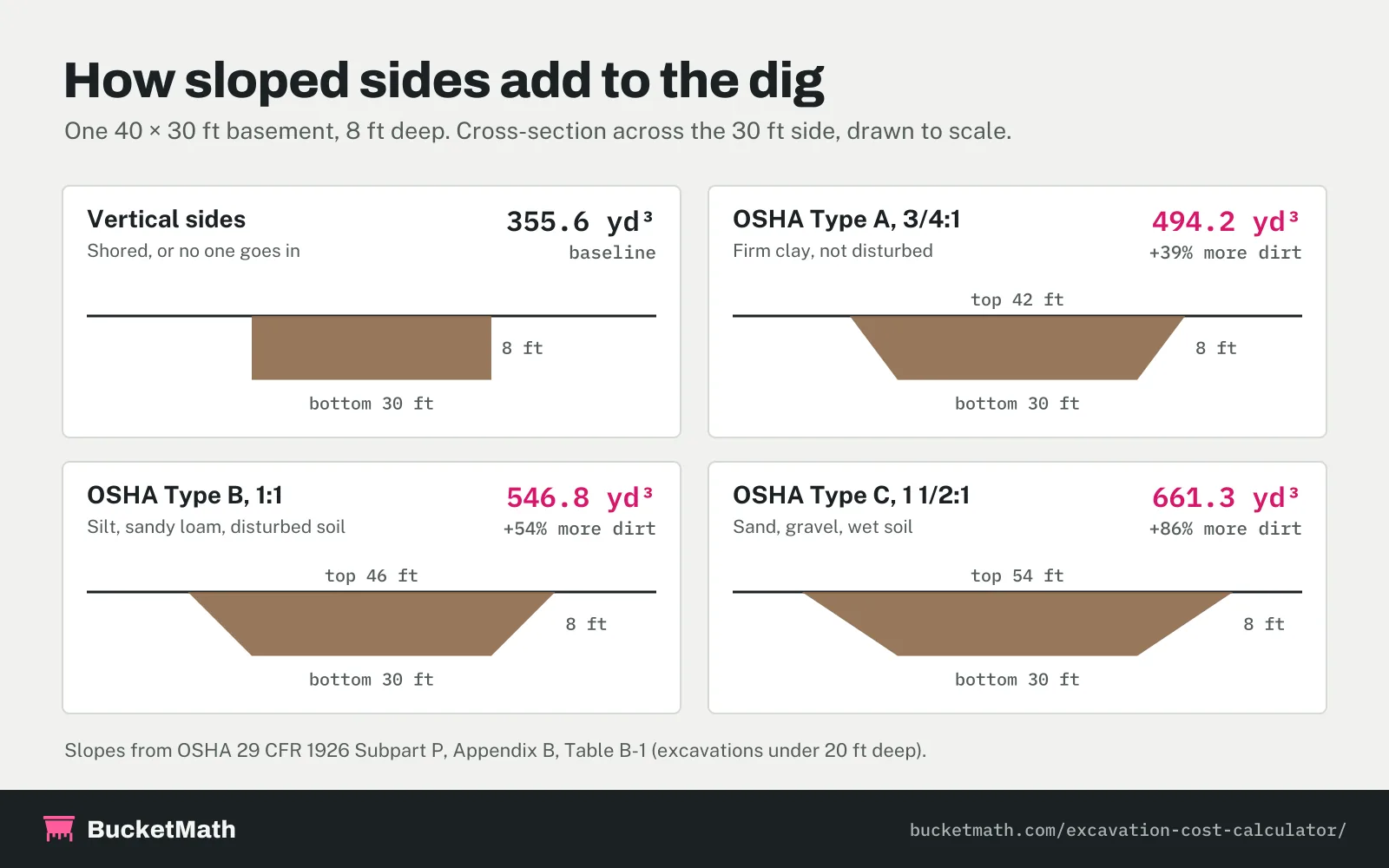
For the 40 × 30 ft basement at 8 ft deep, a 1:1 slope makes the top 56 × 46 ft and the dig 546.8 cubic yards instead of 355.6. The calculator uses the prismoidal formula, which is exact for a pit with straight, evenly sloped sides. Whether a trench box or shoring is cheaper than the extra digging is a question for your contractor.
Excavation cost by project
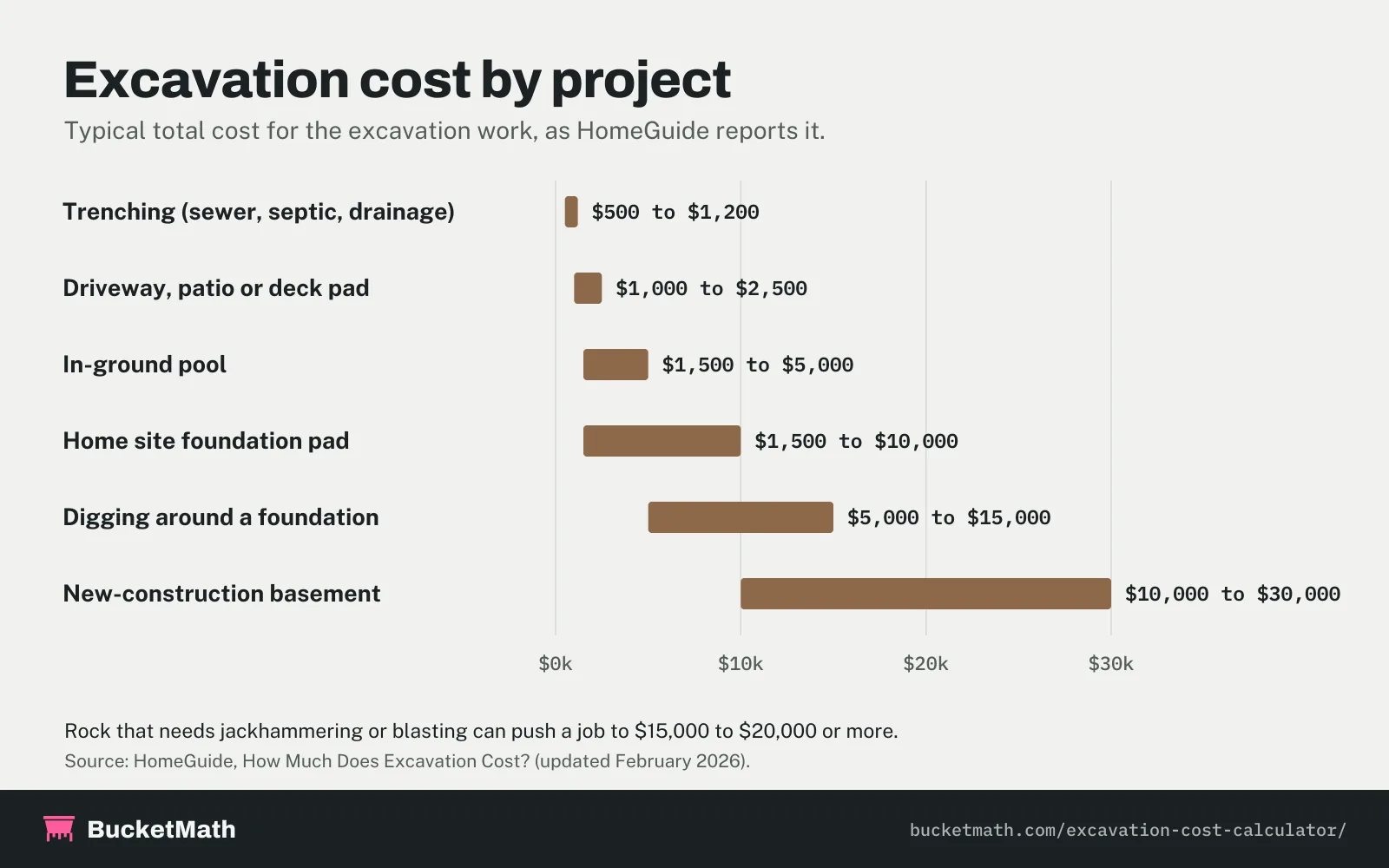
| Basement dig | Typical cost |
|---|---|
| 8 to 9 ft deep, standard soil | $10,000 to $20,000 |
| 10 to 12 ft deep, standard soil | $20,000 to $30,000 |
| 8 to 12 ft, difficult or rocky soil | $30,000 to $50,000+ |
| Under an existing house with a crawl space | $20,000 to $45,000+ |
Why a quote can be far above the per-yard math. The $2,133 to $3,556 in the example covers digging only. A basement quote usually also covers grading, backfill, haul-off, access and the contractor’s setup, which is how HomeGuide arrives at $10,000 to $20,000. Small jobs work the other way: Homewyse’s estimate for a small job, which starts at 10 cubic yards, is $109 to $251 per cubic yard because setup and minimum labor are spread over very little dirt.
Hauling the dirt away
Dirt fluffs up once it is dug, so it fills more trucks than the hole it came from. Multiply the bank volume by the swell for your soil to get the loose volume, then divide by what one truck carries.
| Material | Swell | 100 yd³ dug becomes |
|---|---|---|
| Loam | 15 to 25% | 115 to 125 yd³ |
| Earth | 20 to 30% | 120 to 130 yd³ |
| Sand or gravel, dry | 20 to 30% | 120 to 130 yd³ |
| Clay | 20 to 40% | 120 to 140 yd³ |
| Rock | 40 to 80% | 140 to 180 yd³ |
HomeGuide puts moving dirt at $1,400 to $2,300 per dump-truck load, depending on the distance, equipment and the dirt itself, so ask your hauler for a local per-load price, dump fees included, and enter it in the calculator. The cheapest dirt to haul is dirt that stays: ask whether the spoil can be used for backfill or grading on site. If you need to bring dirt in instead, see the Fill Dirt Calculator.
Other costs to budget for
- Permit: $50 to $400, and most cities require one for earthmoving (HomeGuide).
- Rock: hitting rock can push a basement, foundation or pool dig to $15,000 to $20,000 or more. Make sure the contract says how rock is priced.
- Tree removal: $400 to $1,200 per tree on average (HomeGuide).
- General contractor markup: Homewyse suggests adding 13 to 22 percent if a general contractor supervises the work.
- Utility locate: call 811 a few days before digging. It is free.
Wondering what machine does the work? A compact excavator like the Bobcat E35 digs about 10 ft deep with its standard arm. See all equipment specs.
Frequently asked questions
How much does excavation cost per cubic yard?
HomeGuide lists $2.50 to $6 per cubic yard for light soil, $6 to $10 for average soil, $10 to $15 for heavy or wet soil, and $50 to $200 or more for rock that must be jackhammered.
How do I calculate excavation volume?
Multiply length × width × depth in feet and divide by 27 for cubic yards. A 40 × 30 ft hole 8 ft deep is 9,600 cubic feet, or 355.6 cubic yards. Sloped sides add more.
How much does it cost to dig a basement?
HomeGuide lists $10,000 to $20,000 for an 8 to 9 ft basement in standard soil, $20,000 to $30,000 at 10 to 12 ft, and $30,000 to $50,000 or more in difficult or rocky soil. That covers excavation and grading, not the foundation.
How much does pool excavation cost?
About $1,500 to $5,000 in soft soil without obstructions, rising to $15,000 to $20,000 for hard-to-reach sites, boulders, hardpan or rock that needs jackhammering or blasting (HomeGuide).
How much does an excavator cost per hour?
An operator with an excavator costs $100 to $300 per hour, often with a one-day minimum. Renting the machine alone is about $200 to $700 per day (HomeGuide).
Do the sides of an excavation have to be sloped?
OSHA requires a protective system in excavations 5 ft or deeper unless they are entirely in stable rock. Sloping is one option: 3/4:1 in Type A soil, 1:1 in Type B and 1 1/2:1 in Type C. Shoring or a trench box are the others.
How many truckloads of dirt will I have?
Multiply the dug volume by the swell (about 1.2 to 1.3 for common earth), then divide by the truck size. 355.6 cubic yards of earth becomes about 444 loose yards, or 45 loads in a 10-yard truck.
Sources
- HomeGuide, How Much Does Excavation Cost?, by Kristen Cramer, updated February 5, 2026; and How Much Does It Cost to Dig Out a Basement?, by Jennifer Carlson, updated February 6, 2026.
- Homewyse, Cost to Excavate Land, September 2026 estimate.
- OSHA 29 CFR 1926.652, Appendix A, Soil Classification and Appendix B, Sloping and Benching.
- Engineering ToolBox, Soil and Rock Bulk Factors.
- Volume formulas: prismoidal formula for sloped pits, cone frustum for round ones; 1 cubic yard = 27 cubic feet.