
Enter a length, width and depth in feet, inches or yards and get cubic yards, plus cubic feet, bags, weight and cost. It also converts square feet or cubic feet to cubic yards, and handles circles and triangles.
Volume
2.47yd³
| Cubic feet | 66.7 ft³ |
| Cubic meters | 1.89 m³ |
| Weight | 5,067 lb (2.53 tons) |
| Bags | 67 bags of 1 cu ft |
| One cubic yard covers | 81 sq ft at 4 in deep |
| Cost | Enter a price per yd³ |
Area: 20 ft × 10 ft = 200.0 sq ft. Depth: 4 in ÷ 12 = 0.333 ft. 200.0 × 0.333 = 66.7 ft³ ÷ 27 = 2.47 yd³.
Estimate based on your inputs and the assumptions on this page. Disclaimer
How to calculate cubic yards
Use cubic yards = length (ft) × width (ft) × depth (ft) ÷ 27. One cubic yard is a cube 3 ft on each side, which holds 27 cubic feet, so dividing cubic feet by 27 gives cubic yards.
- Measure the length and width in feet. If you measured in inches, divide by 12. If you measured in yards, multiply by 3.
- Multiply length by width to get the area in square feet.
- Turn the depth into feet by dividing the inches by 12.
- Multiply the area by the depth to get cubic feet.
- Divide by 27 to get cubic yards, and round up when you order.
Example: an area 20 ft × 10 ft is 200 sq ft. At 4 in deep, the depth is 4 ÷ 12 = 0.333 ft, so 200 × 0.333 = 66.7 cubic feet, and 66.7 ÷ 27 = 2.47 cubic yards.
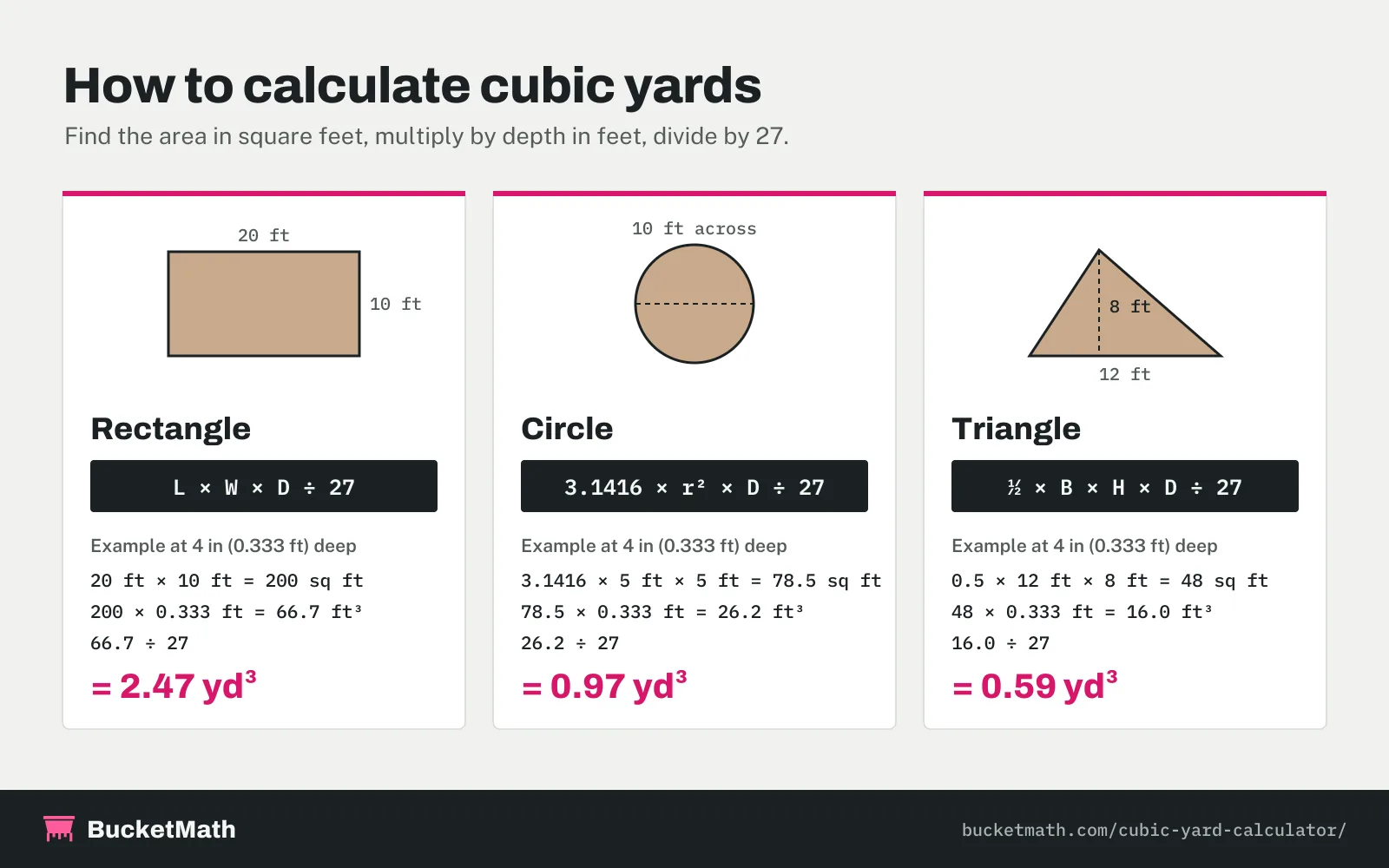
Shortcut when the depth is in inches: square feet × depth in inches ÷ 324, because 27 × 12 = 324. The same example is 200 × 4 ÷ 324 = 2.47.
Cubic yards for a circle, cylinder or triangle
| Shape | Area in square feet | Example at 4 in deep |
|---|---|---|
| Rectangle or square | Length × width | 20 ft × 10 ft = 2.47 yd³ |
| Circle or cylinder | 3.1416 × radius × radius | 10 ft across = 0.97 yd³ |
| Triangle | 0.5 × base × height | 12 ft base, 8 ft height = 0.59 yd³ |
A cylinder, such as a round footing or a post hole, is a circle with depth. Choose Circle in the calculator and enter the height as the depth. A post hole 12 in across and 3 ft deep is 3.1416 × 0.5 × 0.5 × 3 = 2.36 cubic feet, or 0.09 cubic yards.
For an L-shape or any other odd area, split it into rectangles and triangles, work out each piece, and add the results.
Square feet to cubic yards
Square feet measure area and cubic yards measure volume, so you need a depth to get from one to the other: cubic yards = square feet × depth in inches ÷ 324. In the calculator, choose Square feet and enter the area and depth.
| Area | 2 in | 3 in | 4 in | 6 in |
|---|---|---|---|---|
| 100 sq ft | 0.62 | 0.93 | 1.23 | 1.85 |
| 250 sq ft | 1.54 | 2.31 | 3.09 | 4.63 |
| 500 sq ft | 3.09 | 4.63 | 6.17 | 9.26 |
| 1,000 sq ft | 6.17 | 9.26 | 12.35 | 18.52 |
| 2,000 sq ft | 12.35 | 18.52 | 24.69 | 37.04 |
To go the other way, from cubic yards to square feet: square feet covered = cubic yards × 324 ÷ depth in inches. Three cubic yards spread 4 in deep cover 3 × 324 ÷ 4 = 243 sq ft.
Square yards work the same way once you multiply by 9 to get square feet. For example, 50 sq yd is 450 sq ft, and at 3 in deep that is 450 × 3 ÷ 324 = 4.17 cubic yards.
How much does 1 cubic yard cover?
One cubic yard covers 324 sq ft at 1 in deep, 108 sq ft at 3 in and 81 sq ft at 4 in. Divide 324 by the depth in inches.
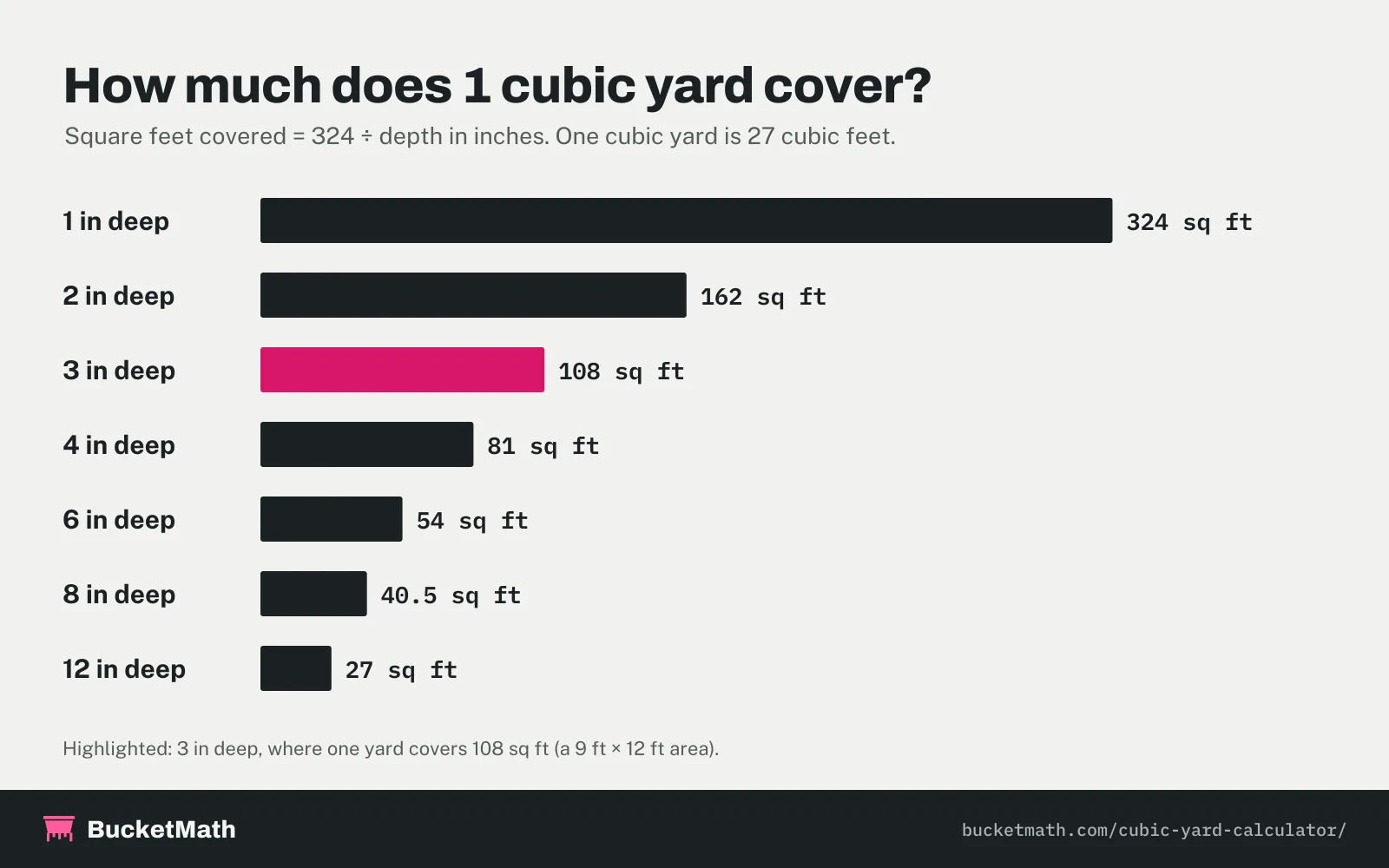
| Depth | Area 1 yd³ covers | About the size of |
|---|---|---|
| 1 in | 324 sq ft | 18 ft × 18 ft |
| 2 in | 162 sq ft | 9 ft × 18 ft |
| 3 in | 108 sq ft | 9 ft × 12 ft |
| 4 in | 81 sq ft | 9 ft × 9 ft |
| 6 in | 54 sq ft | 6 ft × 9 ft |
| 8 in | 40.5 sq ft | 4.5 ft × 9 ft |
| 12 in | 27 sq ft | 3 ft × 9 ft |
Cubic feet to cubic yards
Divide cubic feet by 27. And yes, 27 cubic feet is exactly 1 cubic yard: a yard is 3 ft, and 3 × 3 × 3 = 27. In the calculator, choose Cubic feet and enter the number.
| Convert | Do this | Example |
|---|---|---|
| Cubic feet to cubic yards | ÷ 27 | 135 ft³ = 5 yd³ |
| Cubic yards to cubic feet | × 27 | 3 yd³ = 81 ft³ |
| Cubic inches to cubic yards | ÷ 46,656 | 93,312 in³ = 2 yd³ |
| Cubic meters to cubic yards | × 1.308 | 2 m³ = 2.62 yd³ |
| Cubic yards to cubic meters | × 0.7646 | 3 yd³ = 2.29 m³ |
Cubic yards of concrete, gravel, soil and mulch
The volume math is the same for every material. What changes is the weight, and whether you buy it by the yard, the ton or the bag.
| Material | Weight per cubic yard | Good to know |
|---|---|---|
| Concrete | 3,780 to 4,050 lb | 140 to 150 lb per cubic foot. Ready-mix is ordered by the cubic yard. |
| Gravel, dry | 2,835 lb (1.42 tons) | 105 lb per cubic foot. Often sold by the ton. Our gravel calculator allows for compaction. |
| Gravel, wet | 3,375 lb (1.69 tons) | 125 lb per cubic foot. |
| Sand, dry | 2,619 lb (1.31 tons) | 97 lb per cubic foot. |
| Topsoil (loam) | 2,160 lb (1.08 tons) | See the topsoil calculator for lawn and bed depths. |
| Loose dirt, dry | 2,052 lb (1.03 tons) | See the dirt and fill dirt calculators. |
| Mulch | Not estimated | Weight varies with the wood and how wet it is. Buy mulch by volume. |
Concrete: a 10 × 10 slab
A slab 10 ft × 10 ft and 4 in thick is 100 × 0.333 = 33.3 cubic feet, or 1.23 cubic yards. In bags, Quikrete states that an 80 lb bag of its Concrete Mix yields about 0.60 cubic feet, so the same slab takes 33.3 ÷ 0.60 = 56 bags.
Gravel: a driveway
A driveway 50 ft × 12 ft with 4 in of gravel is 600 × 4 ÷ 324 = 7.41 cubic yards. At 105 lb per cubic foot for dry gravel, that is about 10.5 tons.
Soil and mulch: garden beds
A raised bed 4 ft × 8 ft filled 12 in deep holds 32 cubic feet, or 1.19 cubic yards. Mulch 3 in deep over a 300 sq ft bed is 300 × 3 ÷ 324 = 2.78 cubic yards, which is 38 bags of 2 cu ft.
Digging instead of filling? The excavation cost calculator and trench calculator handle sloped sides and soil that swells once it is dug.
How many bags are in a cubic yard?
Divide 27 by the cubic feet printed on the bag, and round up to whole bags.
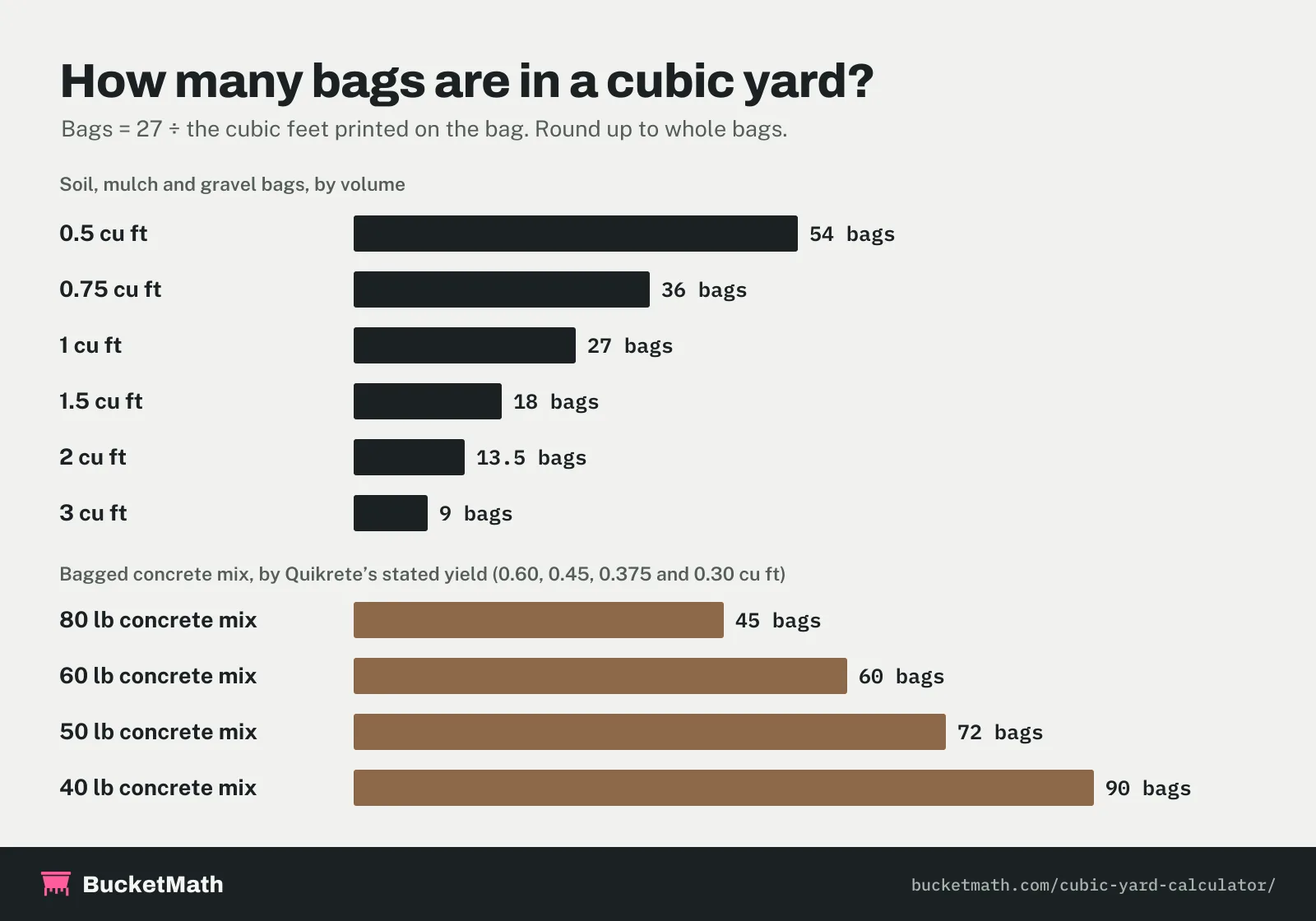
| Bag | Volume per bag | Bags per cubic yard |
|---|---|---|
| Soil, mulch or gravel | 0.5 cu ft | 54 |
| Soil, mulch or gravel | 0.75 cu ft | 36 |
| Soil, mulch or gravel | 1 cu ft | 27 |
| Soil, mulch or gravel | 1.5 cu ft | 18 |
| Soil, mulch or gravel | 2 cu ft | 13.5 (buy 14) |
| Soil, mulch or gravel | 3 cu ft | 9 |
| Concrete mix, 80 lb | 0.60 cu ft | 45 |
| Concrete mix, 60 lb | 0.45 cu ft | 60 |
| Concrete mix, 50 lb | 0.375 cu ft | 72 |
| Concrete mix, 40 lb | 0.30 cu ft | 90 |
How many 40 lb bags of soil are in a cubic yard? Soil bags sold by weight do not all hold the same volume. A Michigan State University Extension answer puts a 40 lb bag of topsoil at about 0.75 cubic feet, which works out to 36 bags per cubic yard. If your bag prints a different volume, divide 27 by that number.
Before you order
- Round up to the next amount your supplier sells, and ask whether they sell half yards.
- Ask whether the material is priced by the cubic yard or by the ton. The weight row in the calculator converts one to the other.
- Measure the depth in several spots. Ground is rarely level, and the average depth is what matters.
- Set your own margin in the Extra field for spillage, uneven ground and settling. For gravel and fill dirt, our gravel and fill dirt calculators build in sourced compaction allowances.
- Call 811 a few days before you dig so buried utility lines can be marked. The service is free.
Frequently asked questions
How much will 1 cubic yard cover?
One cubic yard covers 324 square feet at 1 inch deep, 162 at 2 inches, 108 at 3 inches, 81 at 4 inches and 54 at 6 inches. Divide 324 by the depth in inches.
Is 27 cubic feet equal to 1 cubic yard?
Yes. A yard is 3 feet, so a cubic yard is 3 × 3 × 3 = 27 cubic feet. Divide cubic feet by 27 to get cubic yards.
How many 40 lb bags of soil are in a cubic yard?
About 36, if each bag holds 0.75 cubic feet, the figure a Michigan State University Extension answer gives for a 40 lb bag of topsoil. Bags vary, so divide 27 by the cubic feet printed on yours.
How do I convert cubic yards to square feet?
You need a depth. Square feet covered = cubic yards × 324 ÷ depth in inches. For example, 3 cubic yards spread 4 inches deep cover 3 × 324 ÷ 4 = 243 square feet.
How do I calculate cubic yards?
Multiply length × width × depth, all in feet, and divide by 27. With depth in inches, use square feet × depth in inches ÷ 324. A 20 ft × 10 ft area 4 inches deep is 2.47 cubic yards.
How do I convert square feet to cubic yards?
Multiply the square feet by the depth in inches and divide by 324. For example, 500 square feet at 3 inches deep is 500 × 3 ÷ 324 = 4.63 cubic yards.
How many cubic yards of concrete do I need for a 10 × 10 slab?
A 10 ft × 10 ft slab needs 1.23 cubic yards at 4 inches thick and 1.85 cubic yards at 6 inches thick, before any extra you choose to add.
How many 80 lb bags of concrete make a cubic yard?
45 bags. Quikrete states that an 80 lb bag of its Concrete Mix yields about 0.60 cubic feet, and 27 ÷ 0.60 = 45. A cubic yard takes 60 bags of 60 lb mix.
Sources
- Engineering ToolBox, Dirt and Mud Densities, and Concrete Properties (140 to 150 lb per cubic foot; the calculator uses 145).
- Quikrete, Concrete Mix (No. 1101) data sheet, revised October 2022, for bag yields.
- Ask Extension, Amount of top soil to purchase, answered by a Michigan State University Extension Master Gardener volunteer, June 12, 2017.
- Unit conversions: 1 cubic yard = 27 cubic feet = 46,656 cubic inches = 0.7646 cubic meters; 1 US ton = 2,000 lb.