
Pick your stone, enter the area and depth, and get tons and cubic yards of crushed stone, plus coverage per ton, truckloads and cost. It covers #57, 2B, #67, 3/4 inch, ABC and 2A base, stone dust, pea gravel and river stone, loose or compacted.
Stone you need
2.25tons
| Cubic yards | 1.85 yd³ |
| Cubic feet | 50.0 ft³ |
| Weight | 4,500 lb (1.215 tons per yd³) |
| Other placement | Compacted in place: 2.59 tons (1.4 per yd³) |
| One ton covers | 88.9 sq ft at 3 in deep |
| Bags | 100 bags of 0.5 cu ft |
| Truckloads | 1 (at 15 tons per load) |
| Cost | Enter a price |
Area: 20 ft × 10 ft = 200.0 sq ft. Depth: 3 in ÷ 12 = 0.25 ft. 200.0 × 0.25 = 50.0 ft³ ÷ 27 = 1.85 yd³. 1.85 yd³ × 1.215 tons = 2.25 tons.
Estimate based on your inputs and the assumptions on this page. Disclaimer
How to calculate how much stone you need
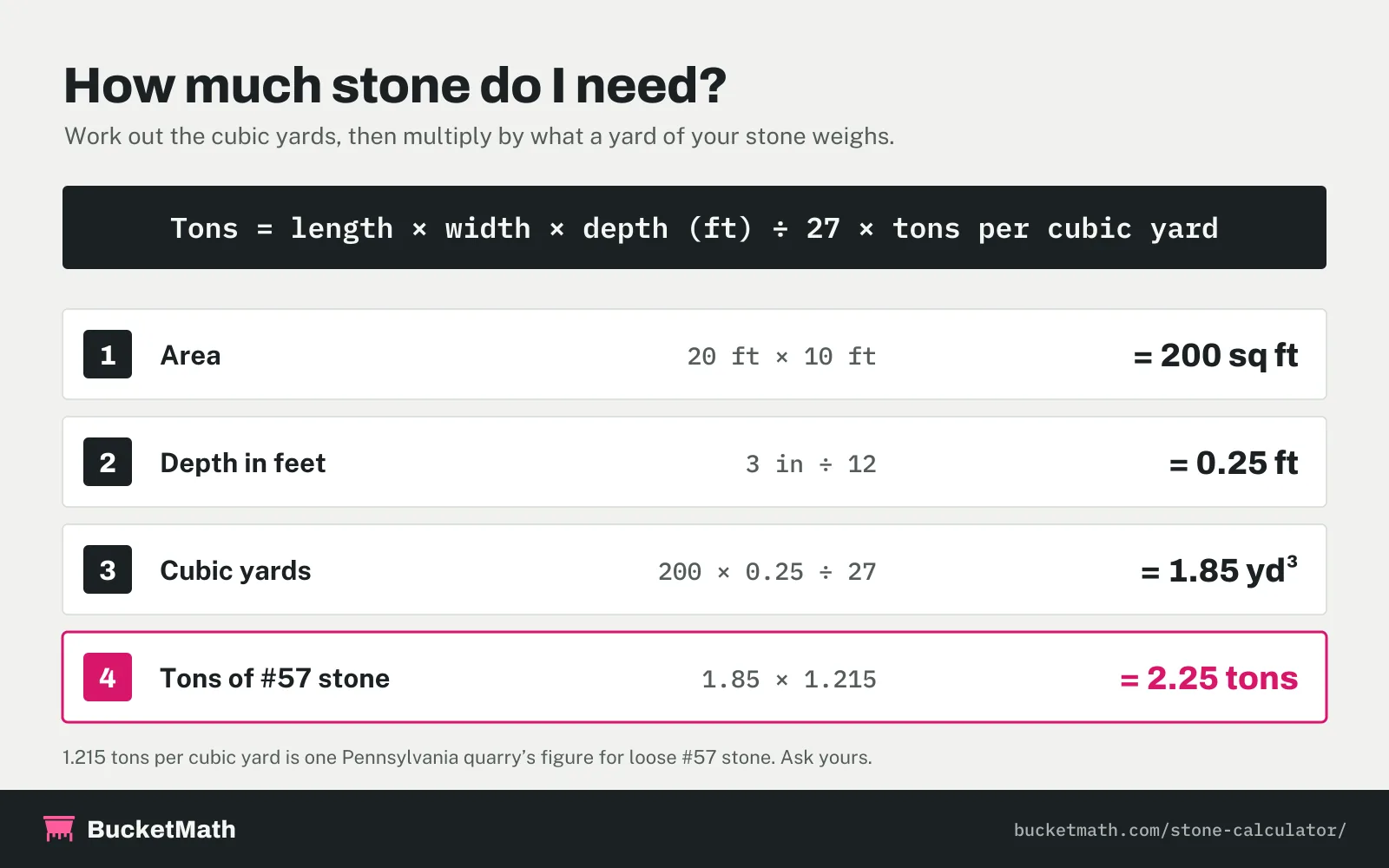
Use tons = length (ft) × width (ft) × depth (ft) ÷ 27 × tons per cubic yard. The first part gives cubic yards. The last number is what one cubic yard of your stone weighs, which depends on the stone and on the quarry.
- Measure the length and width in feet and multiply them to get square feet.
- Divide the depth in inches by 12 to get feet.
- Multiply square feet by depth in feet to get cubic feet, then divide by 27 to get cubic yards.
- Multiply cubic yards by the tons per cubic yard for your stone.
- Round up to what the supplier sells, and check the tons against what your truck or theirs can carry.
Example: an area 20 ft × 10 ft is 200 sq ft. At 3 in deep that is 200 × 0.25 = 50 cubic feet, or 1.85 cubic yards. Loose #57 stone at 1.215 tons per cubic yard makes that 2.25 tons.
If you already know the cubic yards, choose Cubic yards in the calculator and it converts straight to tons. If you only need volume, use our cubic yard calculator.
How many tons are in a cubic yard of stone?
About 1.2 to 1.5 tons for stone placed loose, and up to about 1.8 tons for dense base stone compacted in place. Quarries publish different figures because rock type, size and moisture all change the weight. The table below is what one Pennsylvania quarry, Rohrer’s, uses in its own tonnage calculator.
| Stone | Size the quarry lists | Loose | Compacted |
|---|---|---|---|
| #57 / 2B | 1/4 to 1 1/2 in | 1.215 | 1.400 |
| #67 | 1/4 to 1 in | 1.175 | 1.320 |
| #8 | 1/4 to 1/2 in | 1.175 | 1.301 |
| #3 | 1/2 to 2 1/2 in | 1.202 | 1.364 |
| #1 | 3/4 to 4 in | 1.215 | 1.349 |
| 2A base | Fines to 1 1/2 in | 1.392 | 1.798 |
| Stone dust (#10) | Fines to 3/8 in | 1.322 | 1.505 |
| Pea gravel | 1/2 in | 1.284 | Not listed |
| Pea gravel | 3/4 in | 1.335 | Not listed |
| River stone | 3/8 in | 1.223 | Not listed |
| River stone | 3/4 in | 1.266 | Not listed |
| River stone | 1 to 3 in | 1.286 | Not listed |
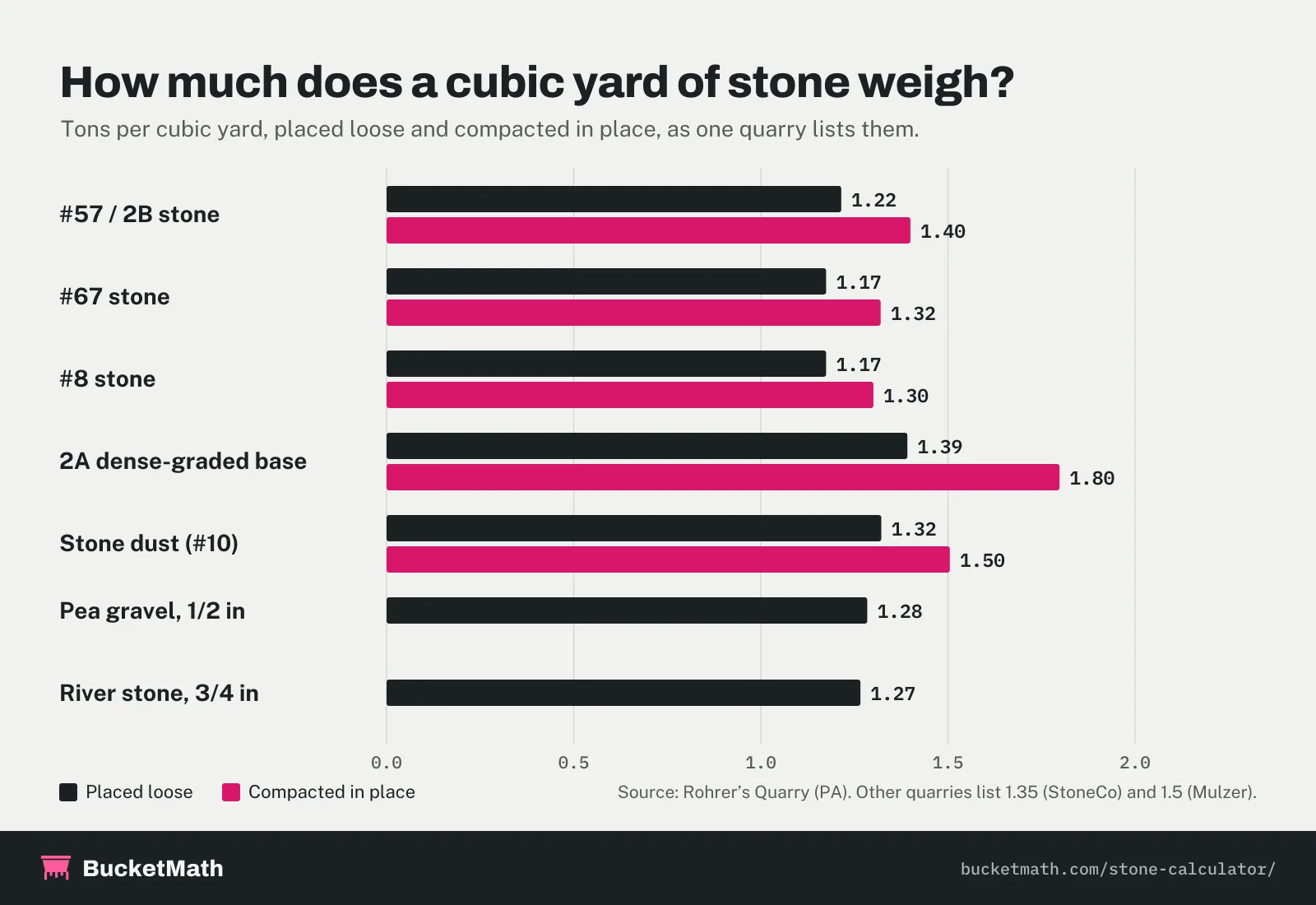
Other quarries use one flat number. Stoneco uses 1.35 tons per cubic yard for loose stone and 2.0 for what it calls process stone. Mulzer Crushed Stone uses 1.5 for every product. Engineering ToolBox lists dry gravel at 105 lb per cubic foot, which is 1.42 tons per cubic yard. That spread is why the same job can come out up to 23 percent apart on two calculators (1.215 against 1.5).
The safe move is to ask your supplier for their tons per cubic yard and enter it under “My supplier’s figure”. If you cannot get one, the 1.5 option in the stone menu gives the higher estimate.
Stone sizes: #57, #67, 2B, 3/4 inch and ABC
The numbers are size grades from the AASHTO standard that state highway departments use. They tell you which sieves the stone passes, not how good it is.
| Name | What it means |
|---|---|
| #57 stone | All of it passes a 1 1/2 in sieve, 95 to 100 percent passes 1 in, 25 to 60 percent passes 1/2 in, and no more than 10 percent passes the No. 4 sieve (about 3/16 in). A clean stone with almost no fines. |
| 2B stone | Pennsylvania’s name for the same size. Rohrer’s lists it as “AASHTO #57/2B”. |
| #67 stone | A little smaller: all of it passes 1 in, 90 to 100 percent passes 3/4 in, and no more than 10 percent passes No. 4. |
| 3/4 inch stone | A trade name, not a specification. Suppliers use it for #57 or for #67, so ask which one you are getting. Their weights are close. |
| ABC stone | Aggregate base course. A blend from 1 1/2 in down to dust: 35 to 55 percent passes No. 4 and 4 to 12 percent passes the No. 200 sieve. The fines let it lock together when compacted. |
| 2A stone | Pennsylvania’s dense-graded base, listed by Rohrer’s as fines to 1 1/2 in. The same kind of material as ABC. |
| Stone dust, #10 | Screenings from fines up to 3/8 in. |
We did not find a North Carolina quarry figure we could verify for the weight of ABC, so the calculator groups it with 2A, which is the same type of stone. Use your supplier’s figure if you have one.
How much does a ton of stone cover?
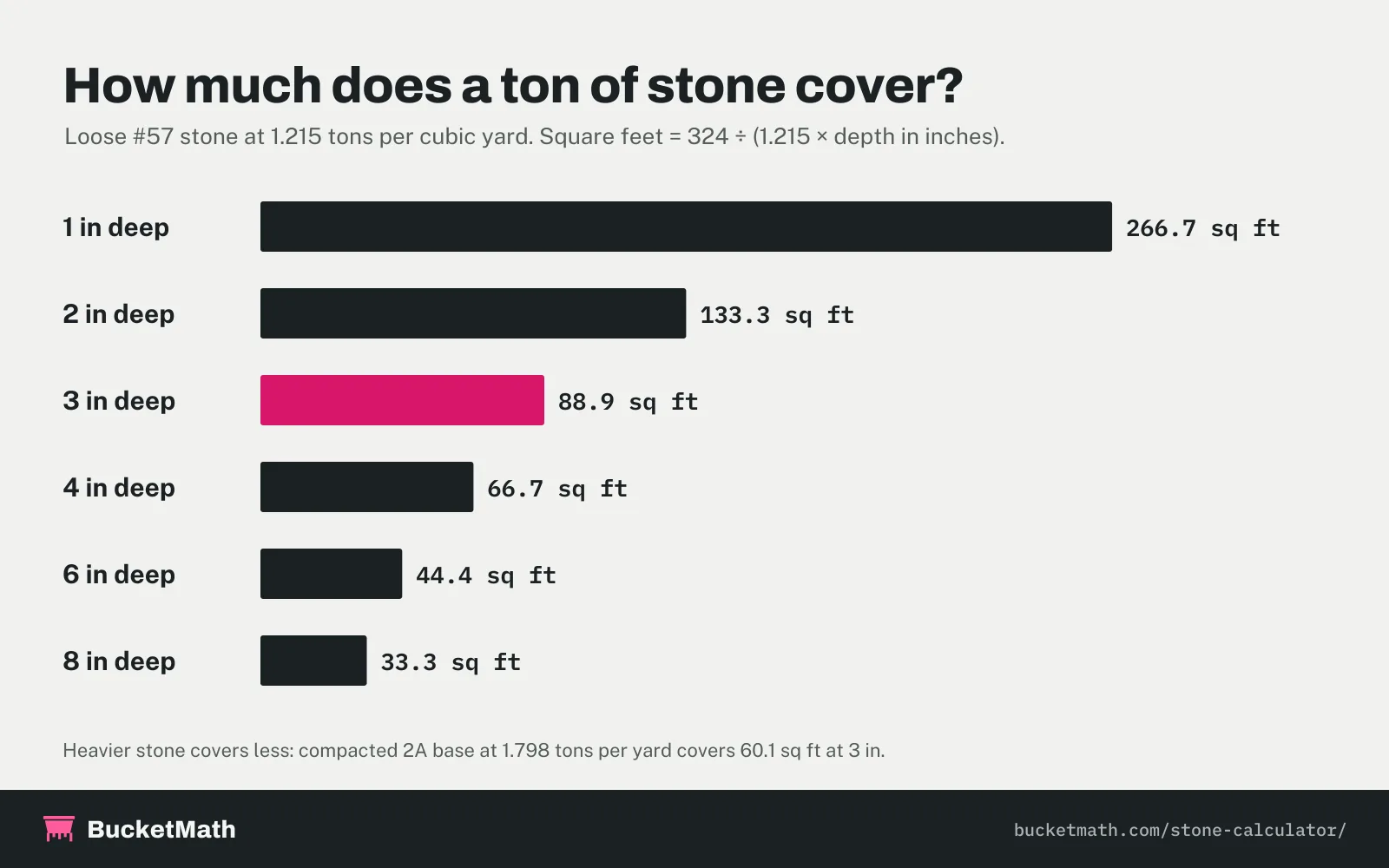
One ton of loose #57 stone covers about 89 sq ft at 3 in deep, 133 sq ft at 2 in and 67 sq ft at 4 in. The rule is square feet = 324 ÷ (tons per cubic yard × depth in inches).
| Depth | #57 stone, loose | 2A base, compacted |
|---|---|---|
| 1 in | 266.7 sq ft | 180.2 sq ft |
| 2 in | 133.3 sq ft | 90.1 sq ft |
| 3 in | 88.9 sq ft | 60.1 sq ft |
| 4 in | 66.7 sq ft | 45.0 sq ft |
| 6 in | 44.4 sq ft | 30.0 sq ft |
| 8 in | 33.3 sq ft | 22.5 sq ft |
Tons of stone by square feet
For loose #57 stone at 1.215 tons per cubic yard, tons = square feet × depth in inches × 0.00375.
| Area | 2 in | 3 in | 4 in | 6 in |
|---|---|---|---|---|
| 100 sq ft | 0.75 | 1.13 | 1.50 | 2.25 |
| 250 sq ft | 1.88 | 2.81 | 3.75 | 5.63 |
| 500 sq ft | 3.75 | 5.63 | 7.50 | 11.25 |
| 1,000 sq ft | 7.50 | 11.25 | 15.00 | 22.50 |
| 2,000 sq ft | 15.00 | 22.50 | 30.00 | 45.00 |
Stone for a driveway
Penn State’s Center for Dirt and Gravel Road Studies says a driving surface placed 6 in loose compacts to about 4 1/2 in, and 8 in loose compacts to a finished 6 in. Dense-graded stone such as 2A or ABC has the fines that let it pack into a firm surface; clean stone such as #57 has almost none.
Example: a driveway 50 ft × 12 ft is 600 sq ft. Entered as 6 in of loose 2A, that is 11.11 cubic yards × 1.392 = 15.5 tons. Entered the other way, as a finished 4 1/2 in compacted, it is 8.33 cubic yards × 1.798 = 15.0 tons. The two routes land within about 3 percent of each other.
For Penn State’s driving surface aggregate itself, and for pea gravel under play equipment, use the gravel calculator, which has those presets.
Landscape, decorative, pea and river stone
For small stone, Utah State University Extension gives 1 to 2 in as the layer for fine, dense mulch material under 1/2 in across, and notes that landscape fabric resists puncture when rock is used as a decorative top cover. Larger stone needs a layer at least as deep as the stones are wide, or the ground shows through.
- Pea gravel bed: 200 sq ft at 2 in deep is 1.23 cubic yards. At 1.284 tons per cubic yard that is 1.59 tons, or 67 bags of 0.5 cu ft.
- River stone border: 200 sq ft of 1 to 3 in river stone at 3 in deep is 1.85 cubic yards, or 2.38 tons at 1.286 tons per cubic yard.
- Decorative stone not on the list: lava rock, marble chips and similar stone weigh very differently, so enter the supplier’s tons per cubic yard instead of guessing.
Before you order
- Ask the quarry for tons per cubic yard for the exact product, and whether they sell by the ton or by the yard.
- Say whether the stone will be compacted. Base stone ordered at its loose weight comes up short once it is rolled.
- Ask what one truckload carries and whether there is a minimum order or a delivery fee.
- Measure depth in several places and use the average.
- Call 811 a few days before you dig or grade so buried utility lines can be marked. The service is free.
Frequently asked questions
How much stone do I need?
Multiply length × width × depth in feet, divide by 27 for cubic yards, then multiply by the tons per cubic yard for your stone. A 20 ft × 10 ft area 3 inches deep is 1.85 cubic yards, or 2.25 tons of loose #57 stone at 1.215 tons per yard.
How many tons are in a cubic yard of stone?
About 1.2 to 1.5 tons placed loose, depending on the stone and the quarry. One Pennsylvania quarry lists #57 stone at 1.215 tons loose and 1.40 compacted, and 2A base at 1.39 loose and 1.80 compacted. Other quarries use a flat 1.35 or 1.5.
How much does a ton of stone cover?
A ton of loose #57 stone at 1.215 tons per cubic yard covers about 133 square feet at 2 inches deep, 89 square feet at 3 inches and 67 square feet at 4 inches. Heavier or compacted stone covers less.
What is #57 stone?
A clean crushed stone graded so that all of it passes a 1 1/2 inch sieve, 95 to 100 percent passes 1 inch, 25 to 60 percent passes 1/2 inch and no more than 10 percent passes the No. 4 sieve. Much of it is between 1/2 and 1 inch.
Is 2B stone the same as #57 stone?
Yes. 2B is the Pennsylvania name for the size AASHTO calls No. 57. Pennsylvania quarries such as Rohrer’s list it as AASHTO #57/2B.
What size is 3/4 inch crushed stone?
3/4 inch stone is a trade name, not a specification. Suppliers use it for #57, which runs up to 1 inch, or for #67, where 90 to 100 percent passes a 3/4 inch sieve. Ask which one you are getting.
What is ABC stone?
ABC stands for aggregate base course. It is a blend from 1 1/2 inches down to dust, with 4 to 12 percent passing the No. 200 sieve, so it compacts into a firm base under driveways, slabs and pavers.
How deep should stone be for a driveway?
Penn State’s Center for Dirt and Gravel Road Studies says a driving surface placed 6 inches loose compacts to about 4 1/2 inches, and 8 inches loose compacts to a finished 6 inches.
Sources
- Rohrer’s Quarry, Stone Tonnage Calculator (Lititz, Pennsylvania), product weights, checked October 6, 2026.
- Stoneco, Material Calculators and Mulzer Crushed Stone, Aggregate Calculator, for the flat figures other quarries use, checked October 6, 2026.
- North Carolina DOT, Standard Specifications (2012), Table 1005-1, Aggregate Gradation, for #57, #67 and ABC.
- Penn State Center for Dirt and Gravel Road Studies, Driving Surface Aggregate (DSA) Handbook, April 2025.
- Utah State University Extension, Using Mulches in Utah Landscapes and Gardens, December 2010.
- Engineering ToolBox, Dirt and Mud Densities. Unit conversions: 1 cubic yard = 27 cubic feet; 1 US ton = 2,000 lb.