
Work out how much fill dirt to order so a hole, low spot or pad is still full after you pack it down. Enter the finished size, pick the fill type, and the calculator adds the extra for compaction using published swell factors.
Loose fill dirt to order
8.33yd³
| Packed volume to fill | 6.67 yd³ |
| Extra for swell | +25% (1.67 yd³) |
| Order range | 8.00 to 8.67 yd³ |
| Weight | 17,100 lb (8.55 tons) |
| Truckloads | 1 (at 10 yd³ per load) |
| Cost | Enter a price per yd³ |
Area 12 ft × 10 ft = 120.0 sq ft × 18 in (1.5 ft) = 180.0 ft³ ÷ 27 = 6.67 yd³ compacted. × 1.25 for swell = 8.33 yd³ loose to order.
Estimate based on your inputs and the assumptions on this page. Disclaimer
Why you need more fill dirt than the hole measures
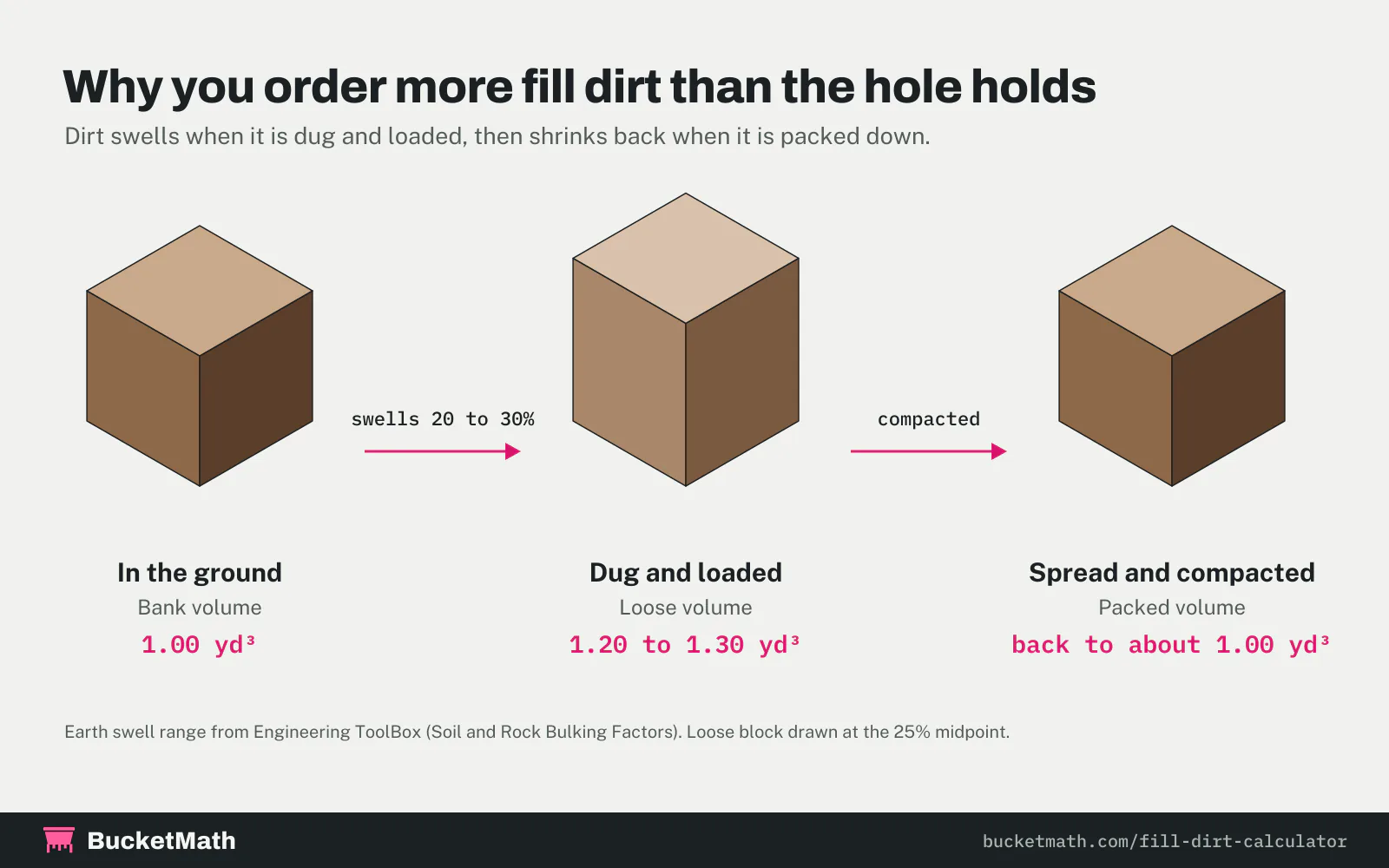
Dirt in the ground is dense. Once it is dug and loaded, it breaks up and takes more space, which is called swell. Engineering ToolBox lists swell of 20 to 30 percent for earth, 15 to 25 percent for loam and 20 to 40 percent for clay. When you spread that loose dirt and compact it, it shrinks back toward its in-ground volume.
Fill is delivered and priced by the loose cubic yard in the truck, so you order more than the finished hole holds.
How to calculate fill dirt with compaction
The formula is loose cubic yards to order = length × width × depth (ft) ÷ 27 × (1 + swell).
- Measure the finished size in feet: the area and the depth you want after packing.
- Multiply length × width × depth to get cubic feet, then divide by 27 for packed cubic yards.
- Pick a swell percentage for your fill type from the table below.
- Multiply the packed cubic yards by 1 plus the swell, for example × 1.25 for 25 percent.
12 ft × 10 ft × 1.5 ft = 180 ft³ ÷ 27 = 6.67 yd³ packed × 1.25 = 8.33 yd³ to order
That hole, 12 ft by 10 ft and 18 inches deep, needs 6.67 packed cubic yards. With common fill at 25 percent swell you order about 8.33 cubic yards, or 8.00 to 8.67 cubic yards across the 20 to 30 percent range.
Swell factors by fill type
| Fill type | Swell | Loose yd³ per packed yd³ |
|---|---|---|
| Common fill (earth) | 20 to 30% | 1.20 to 1.30 |
| Loam | 15 to 25% | 1.15 to 1.25 |
| Clay | 20 to 40% | 1.20 to 1.40 |
Plan for the high end when running short would mean paying for a second delivery. The low end suits fill that will only be lightly tamped, such as a raised garden area.
Fill dirt for common jobs
| Job | Size | Packed | To order |
|---|---|---|---|
| Fill a low spot | 10 ft × 10 ft, 4 in deep | 1.23 yd³ | 1.54 yd³ |
| Backfill a trench | 40 ft × 1.5 ft, 3 ft deep | 6.67 yd³ | 8.33 yd³ |
| Fill a round pool site | 12 ft across, 1 ft deep | 4.19 yd³ | 5.24 yd³ |
| Build up a pad | 20 ft × 30 ft, 6 in deep | 11.11 yd³ | 13.89 yd³ |
| Raise a yard | 1,000 sq ft, 6 in deep | 18.52 yd³ | 23.15 yd³ |
Fill dirt vs. topsoil
Fill dirt is subsoil: the mineral layer under the topsoil, with little organic matter. That makes it the right choice for building up grade under slabs, patios and walkways, because there is little material in it to break down and settle later. Topsoil is the dark, organic top layer that plants grow in.
A common approach is to build up the grade with fill and finish with a few inches of topsoil where you want grass or plants. For plain volume without a compaction allowance, such as topsoil for a bed, use the Dirt Calculator.
How to compact fill dirt
- Spread fill in thin layers and compact each layer before adding the next. A thick layer stays loose at the bottom and settles later.
- Compact soil that is slightly damp. Very dry soil does not bind, and soaked soil turns to mud under a compactor.
- Use a hand tamper for small spots and a plate compactor for larger areas.
- Call 811 a few days before you dig so buried utility lines can be marked. The service is free.
Frequently asked questions
How much extra fill dirt should I order?
For common fill dirt, about 20 to 30 percent more than the finished, packed volume, based on Engineering ToolBox swell factors for earth. Loam needs about 15 to 25 percent more and clay 20 to 40 percent more.
How do I calculate fill dirt for a hole?
Multiply length × width × depth in feet, divide by 27, then multiply by 1 plus the swell percentage. A 12 ft × 10 ft hole 18 inches deep needs 6.67 packed cubic yards, or about 8.33 cubic yards of loose common fill.
How much fill dirt do I need to raise my yard 6 inches?
Every 1,000 square feet raised 6 inches needs 18.52 packed cubic yards, which is about 23.15 cubic yards of loose common fill at 25 percent swell.
Does fill dirt settle?
Yes. Loose fill settles as rain, traffic and its own weight push the air out. Compacting it in thin layers when you place it reduces how much it settles later.
How much does a cubic yard of fill dirt weigh?
Loose dirt weighs about 2,050 to 2,100 pounds per cubic yard and dry clay about 2,700 pounds, based on Engineering ToolBox densities. Wet soil weighs more.
Sources
- Swell factors: Engineering ToolBox, Soil and Rock Bulking Factors.
- Soil weights: Engineering ToolBox, Dirt and Mud Densities.
- Unit conversions: 1 cubic yard = 27 cubic feet; 1 US ton = 2,000 lb.