
Enter the length, width and depth of your area to see how many cubic yards of dirt you need, what it weighs, and how many bags or truckloads that is. The math is shown under the result.
Dirt you need
5.33yd³
| Cubic feet | 144.0 ft³ |
| Cubic meters | 4.08 m³ |
| Weight | 10,944 lb (5.47 tons) |
| Bags | 144 bags of 1 cu ft |
| Truckloads | 1 (at 10 yd³ per load) |
| Cost | Enter a price per yd³ |
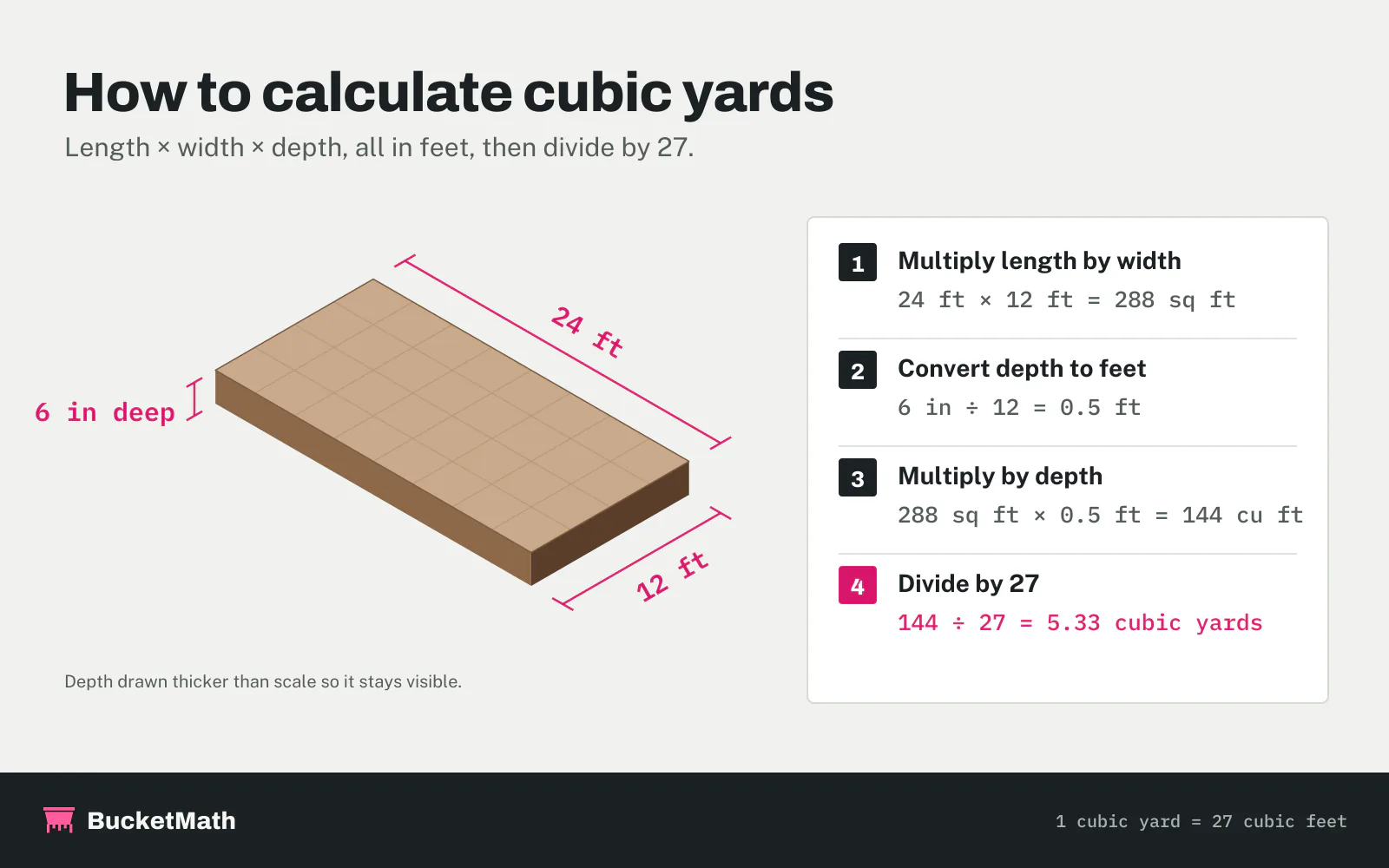
Area: 24 ft × 12 ft = 288.0 sq ft. Depth: 6 in ÷ 12 = 0.5 ft. 288.0 × 0.5 = 144.0 ft³ ÷ 27 = 5.33 yd³.
Estimate based on your inputs and the assumptions on this page. Disclaimer
How to calculate how much dirt you need
The dirt formula is cubic yards = length (ft) × width (ft) × depth (ft) ÷ 27. You divide by 27 because one cubic yard holds 27 cubic feet.
- Measure the length and width in feet. For an odd shape, split it into rectangles, circles and triangles and add the areas together.
- Measure the depth in inches at the deepest point and divide by 12 to get feet.
- Multiply length × width × depth to get cubic feet.
- Divide by 27 to get cubic yards.
- If the dirt will be packed down, add 10 to 25 percent so you do not come up short, or use the Fill Dirt Calculator, which adds it for you by soil type.
Dirt for round and triangular areas
Work out the area first, then multiply by the depth in feet and divide by 27 as usual.
| Shape | Area formula | Example | Dirt needed |
|---|---|---|---|
| Rectangle | length × width | 24 ft × 12 ft, 6 in deep | 5.33 yd³ |
| Circle | 3.1416 × radius² | 10 ft across, 4 in deep | 0.97 yd³ |
| Triangle | base × height ÷ 2 | 12 ft base, 8 ft high, 6 in deep | 0.89 yd³ |
The radius is half the diameter. For the circle above: 3.1416 × 5 ft × 5 ft = 78.54 sq ft, × 0.333 ft = 26.18 cubic feet, ÷ 27 = 0.97 cubic yards.
Cubic yards of dirt by area and depth
For a quick check, find your area in square feet and read across to your depth.
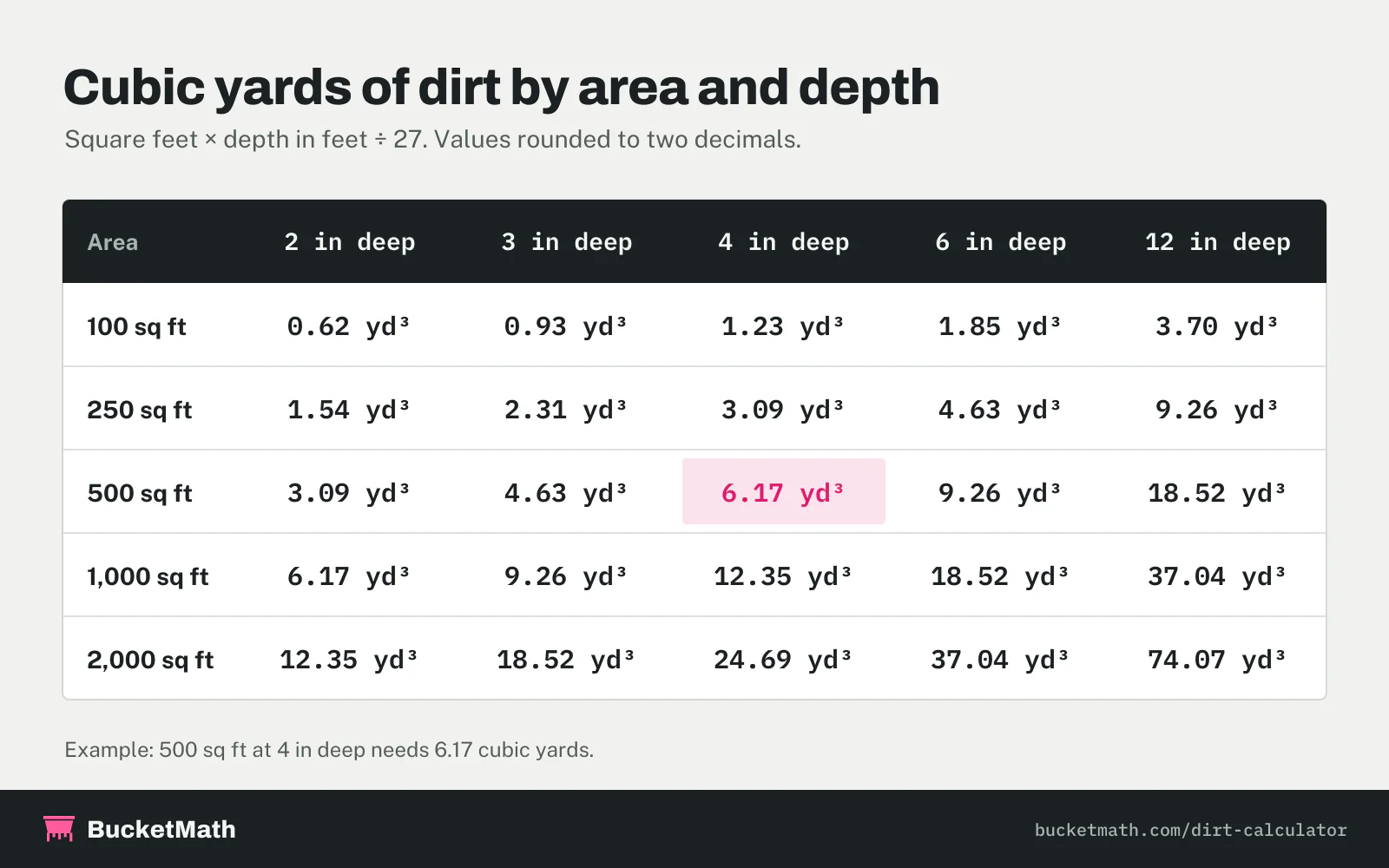
| Area | 2 in | 3 in | 4 in | 6 in | 12 in |
|---|---|---|---|---|---|
| 100 sq ft | 0.62 | 0.93 | 1.23 | 1.85 | 3.70 |
| 250 sq ft | 1.54 | 2.31 | 3.09 | 4.63 | 9.26 |
| 500 sq ft | 3.09 | 4.63 | 6.17 | 9.26 | 18.52 |
| 1,000 sq ft | 6.17 | 9.26 | 12.35 | 18.52 | 37.04 |
| 2,000 sq ft | 12.35 | 18.52 | 24.69 | 37.04 | 74.07 |
How much does a cubic yard of dirt weigh?
A cubic yard of loose dirt weighs about 2,050 to 2,100 pounds, a little over one ton. Clay is much heavier: about 2,700 pounds dry and 2,970 pounds wet. These figures are Engineering ToolBox density values multiplied by 27.
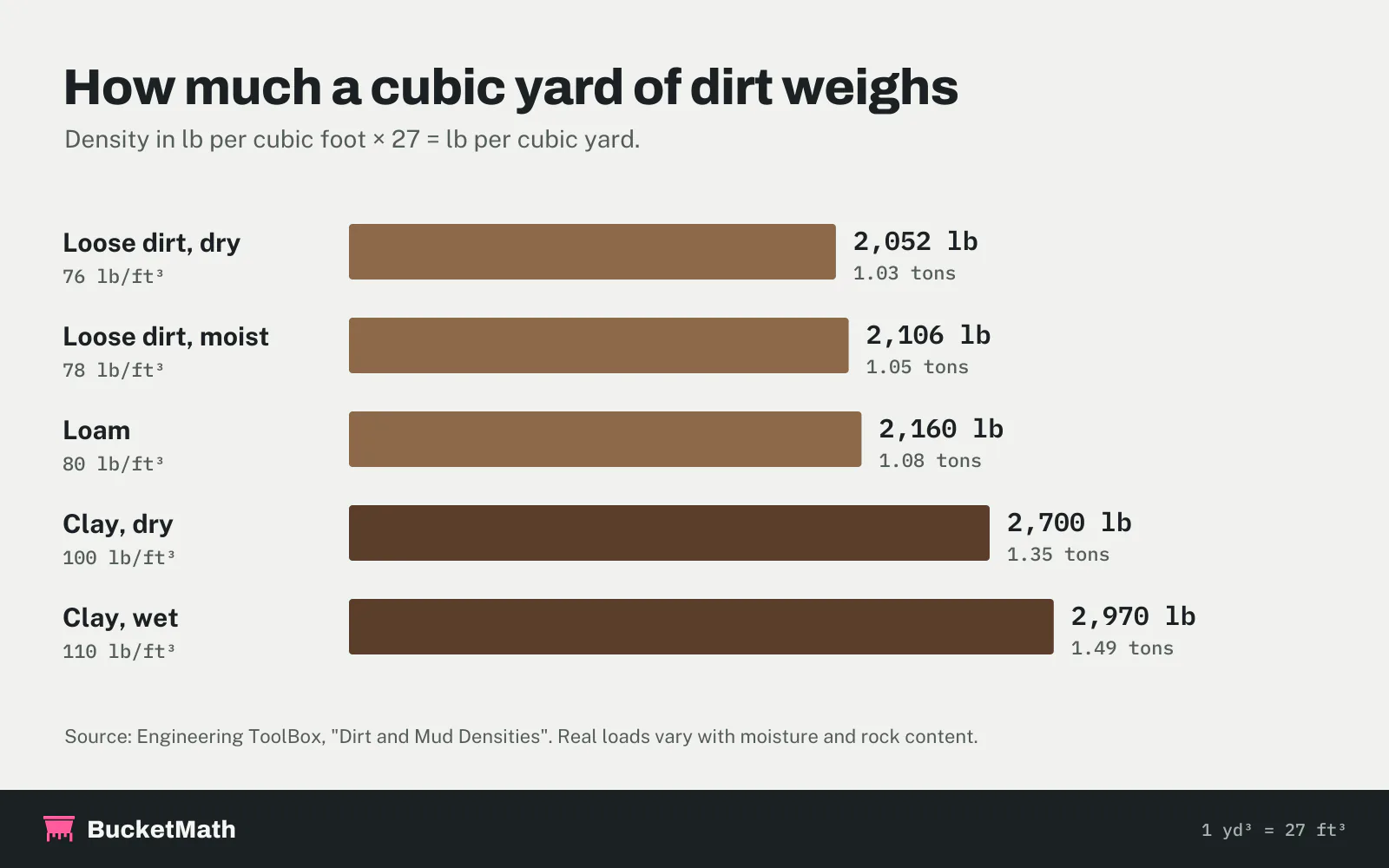
| Soil | lb per ft³ | lb per yd³ | Tons per yd³ |
|---|---|---|---|
| Loose dirt, dry | 76 | 2,052 | 1.03 |
| Loose dirt, moist | 78 | 2,106 | 1.05 |
| Loam | 80 | 2,160 | 1.08 |
| Clay, dry | 100 | 2,700 | 1.35 |
| Clay, wet | 110 | 2,970 | 1.49 |
Delivered dirt can weigh more or less than this depending on moisture and rock content. If your supplier sells by the ton, ask what weight they use per cubic yard.
How many bags of dirt are in a cubic yard?
Divide 27 by the bag size in cubic feet. Bagged soil is handy for a raised bed or a few holes; for anything over a cubic yard or two, bulk delivery saves a lot of carrying.
| Bag size | Bags per cubic yard |
|---|---|
| 0.75 cu ft | 36 |
| 1 cu ft | 27 |
| 1.5 cu ft | 18 |
| 2 cu ft | 13.5 (buy 14) |
Before you order
- Measure depth in several spots. Use the deepest reading for holes, or the average for gently sloping ground.
- Ask your supplier whether they sell by the cubic yard or by the ton, and how much one truckload holds.
- Check that a dump truck can reach the drop spot and that the ground can take its weight.
- Call 811 a few days before you dig so buried utility lines can be marked. The service is free.
Frequently asked questions
How many cubic yards of dirt do I need?
Multiply length × width × depth in feet and divide by 27. For example, a 20 ft × 10 ft area filled 4 inches deep is 20 × 10 × 0.333 = 66.7 cubic feet, or 2.47 cubic yards.
How much does a yard of dirt weigh?
About 2,050 to 2,160 pounds for loose dirt and loam, and 2,700 to 2,970 pounds for clay, based on Engineering ToolBox densities. Wet soil weighs more than dry soil.
How many bags of dirt are in a yard?
27 bags of 1 cubic foot, 36 bags of 0.75 cubic feet, or 14 bags of 2 cubic feet (13.5 rounded up).
How many cubic feet are in a yard of dirt?
27 cubic feet. A cubic yard is 3 feet long, 3 feet wide and 3 feet deep.
How do I calculate dirt for a round area?
Find the area with 3.1416 × radius × radius, multiply by the depth in feet, then divide by 27. A circle 10 ft across and 4 inches deep needs about 0.97 cubic yards.
Sources
- Soil densities: Engineering ToolBox, Dirt and Mud Densities.
- Unit conversions: 1 cubic yard = 27 cubic feet = 0.7646 cubic meters; 1 US ton = 2,000 lb.